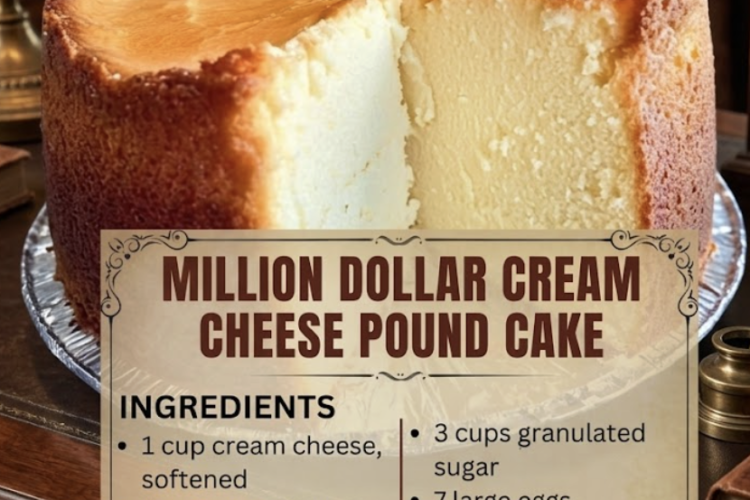
Every Southern baker knows that when a recipe carries the “Million Dollar” title, it promises a crumb so rich, velvety, and dense that it tastes like pure luxury. This particular variation takes the classic pound cake formula and turns the decadence up to eleven by combining two rich, cultured dairy heavyweights: cream cheese and full-fat sour cream.
The interplay between these ingredients is pure culinary magic. While the four sticks of butter deliver that traditional, golden bakery richness, the cream cheese tightens the crumb into a soft, melt-in-your-mouth velvet. Meanwhile, the sour cream brings a subtle, tangy brightness that cuts through the intense sweetness, while its natural lactic acid works behind the scenes to tenderize the flour’s gluten structure. The result is a cake that boasts a crackly, sugary top crust hiding a dense, perfectly moist interior that never turns dry or bready.
Ingredients
For the Cake Batter:
- 1 cup (8 oz / 225 g) cream cheese, full-fat, softened to true room temperature
- 1 cup (8 oz / 240 g) full-fat sour cream, room temperature
- 4 sticks (2 cups / 450 g) unsalted butter, softened to room temperature
- 3 cups (600 g) granulated sugar
- 7 large eggs, strictly at room temperature
- 3 cups (360 g) all-purpose flour, sifted
- ½ teaspoon fine sea salt
- 1 tablespoon pure vanilla extract
- ½ teaspoon pure almond extract or lemon extract (optional, for that signature bakery aroma)
For the Classic Vanilla Bean Glaze (Optional):
- 1 ½ cups (180 g) powdered sugar, sifted
- 2 to 3 tablespoons heavy cream or whole milk
- 1 teaspoon vanilla bean paste or pure vanilla extract
Step-by-Step Instructions
Step 1: Prep Your Pan and Oven
Preheat your oven to 325°F (165°C), placing the oven rack directly in the center position.
Preparing the pan properly is crucial for a cake this heavy in sugar and dairy. Take a large 10-to-12-cup tube pan or heavy cast-aluminum Bundt pan. Grease every nook, cranny, and central chimney thoroughly using solid vegetable shortening or melted butter, then dust generously with all-purpose flour, tapping out any excess. Alternatively, use a professional baker’s release spray that contains flour.
Step 2: The Extended Creaming Phase
In the bowl of a stand mixer fitted with the paddle attachment (or using a heavy-duty hand mixer), combine the 4 sticks of softened butter, 1 cup softened cream cheese, and 1 cup sour cream. Beat on medium speed for about 2 minutes until the dairy fats are completely emulsified, silky, and uniform in color.
With the mixer running on medium speed, gradually stream in the 3 cups of granulated sugar. Once all the sugar is in, turn the speed up to medium-high and let it cream for 5 to 7 full minutes. Do not rush this step! The sugar crystals are slicing through the thick fats, creating millions of tiny air pockets that give this dense cake its lift. The mixture should turn exceptionally pale, almost white, and look like whipped frosting.
Step 3: Emulsify the Eggs and Extracts
Turn the mixer speed down to medium-low. Add the 7 room-temperature eggs one at a time. Wait until each egg is fully incorporated into the batter before cracking in the next.
Once the last egg disappears, stop the mixer and scrape down the bottom and sides of the bowl with a flexible rubber spatula to ensure no unmixed butter remains hidden at the bottom. Stir in the 1 tablespoon vanilla extract and ½ teaspoon almond extract.
Step 4: Fold the Dry Ingredients
Sift together the 3 cups all-purpose flour and ½ teaspoon fine salt.
With the mixer on the absolute lowest speed—or by hand using a large wooden spoon—add the flour mixture to the batter in three equal additions. Mix just until the white streaks of flour vanish. Overmixing at this stage will overwork the gluten, turning your luxurious, velvety cake tough and rubbery.
Step 5: Bake Low and Slow
Spoon the thick, silky batter into your prepared pan. Smooth the top with an offset spatula, then firmly tap the pan against your kitchen counter three or four times to force any trapped air pockets to rise to the surface and pop.
Place the pan into the preheated oven and bake at 325°F (165°C) for 1 hour 15 minutes to 1 hour 30 minutes. Resist the urge to open the oven door during the first hour! The cake is finished when the top is a deep golden brown, the edges begin to pull away slightly from the sides of the pan, and a long wooden skewer inserted deep into the center comes out clean or with just a few moist crumbs attached.
Step 6: The Cooling Ritual
Transfer the pan to a wire cooling rack and let the cake rest undisturbed in the pan for exactly 20 minutes. The cake needs this time for its delicate starch structure to set, but leaving it in the pan any longer will cause the cooling sugars to stick to the metal walls.
Run a thin, flexible butter knife gently around the outer edges and center tube. Place a serving platter or cooling rack over the top of the pan, grasp both firmly, and flip them over together. The cake should slide right out. Allow it to cool completely to room temperature before glazing or slicing.
Pro-Tips for Perfection
- Temperature is Everything: Because this recipe contains a massive amount of fat across butter, cream cheese, sour cream, and eggs, temperature consistency is non-negotiable. If you add cold eggs to room-temperature butter, the butter will instantly seize and curdle, breaking the emulsion and leading to a heavy, flat layer at the bottom of your baked cake (often called a “sad streak”). Pull all your cold ingredients out of the fridge at least 1.5 to 2 hours before you start baking.
- The “Day Two” Secret: While this cake is delicious warm, it becomes truly extraordinary if you wrap it tightly in plastic wrap once fully cooled and let it sit at room temperature overnight. The moisture redistributes through the dense crumb, softening the edges and making the flavor twice as deep the next day.