🇫🇷💛 French Macarons
Delicate, elegant, and irresistibly chewy, these classic French Macarons feature smooth almond shells with crisp edges, soft centers, and a luscious buttercream filling.
Made with finely ground almond flour, powdered sugar, and a carefully prepared Italian meringue, these macarons have the signature smooth tops and delicate ruffled feet that make them so special.
The optional yellow coloring gives them a beautiful sunny finish, while the creamy buttercream adds the perfect sweet, buttery contrast.
⏱️ Recipe Information
Prep Time: 35 minutes
Resting Time: 30–60 minutes
Bake Time: 12–15 minutes per tray
Cooling Time: 30 minutes
Maturing Time: 12–24 hours
Total Time: About 2½–3 hours, plus maturing
Yield: 20–24 filled macarons
Difficulty: Intermediate
Method: Italian Meringue
🛒 Ingredients
🥚 For the Macaron Shells
- 100g very fine almond flour, sifted
- 100g powdered sugar, sifted
- 70g egg whites, divided if possible
- 100g granulated sugar
- 30ml water
- Yellow food coloring, optional
Important: Weigh the ingredients with a digital kitchen scale. Macarons are highly sensitive to ingredient ratios.
🧈 For the Buttercream Filling
- 115g unsalted butter, softened
- 120g powdered sugar, sifted
- 1 teaspoon vanilla extract
- 1–2 tablespoons heavy cream or milk, as needed
- Pinch of salt
Optional
- Yellow food coloring
- ½ teaspoon lemon zest
- 1 tablespoon lemon juice for a lemon buttercream variation
👩🍳 Instructions
🥚 Prepare the Macaron Batter
1. Prepare the Baking Trays
Line two baking sheets with silicone macaron mats or parchment paper.
If using parchment, place a macaron template underneath to help create evenly sized shells.
Set aside.
2. Make the Almond Flour Mixture
In a large bowl, sift together:
- Almond flour
- Powdered sugar
Sift them at least once, preferably twice.
Discard any large almond pieces left in the sieve.
This creates a finer mixture and helps produce smooth macaron shells.
3. Add Half of the Egg Whites
Add 35g egg whites to the almond flour and powdered sugar mixture.
Mix with a spatula until it forms a thick almond paste.
Set aside.
🍯 Make the Italian Meringue
4. Start the Sugar Syrup
Add the granulated sugar and water to a small saucepan.
Heat over medium heat.
Do not stir once the sugar has dissolved.
Bring the syrup to 118°C (244°F).
Use a candy or instant-read thermometer for the most reliable results.
5. Whip the Egg Whites
While the sugar syrup is heating, place the remaining 35g egg whites into a clean, grease-free mixing bowl.
Begin whipping on medium speed.
You want the whites to become foamy and begin forming soft peaks as the syrup approaches temperature.
6. Add the Hot Syrup
When the sugar syrup reaches 118°C (244°F), slowly pour it into the whipping egg whites in a thin, steady stream.
Keep the mixer running.
Pour the syrup down the side of the bowl rather than directly onto the whisk.
Continue whipping until the meringue becomes thick, glossy, and forms stiff peaks.
The bowl should also feel noticeably cooler.
🎨 Combine the Batter
7. Add the Meringue to the Almond Mixture
Add approximately one-third of the Italian meringue to the almond paste.
Fold gently with a spatula to loosen the mixture.
Add another third and fold.
Finally, add the remaining meringue.
8. Add the Food Coloring
If using yellow food coloring, add a small amount while folding.
Gel or concentrated food coloring is preferable because it adds strong color without introducing excess liquid.
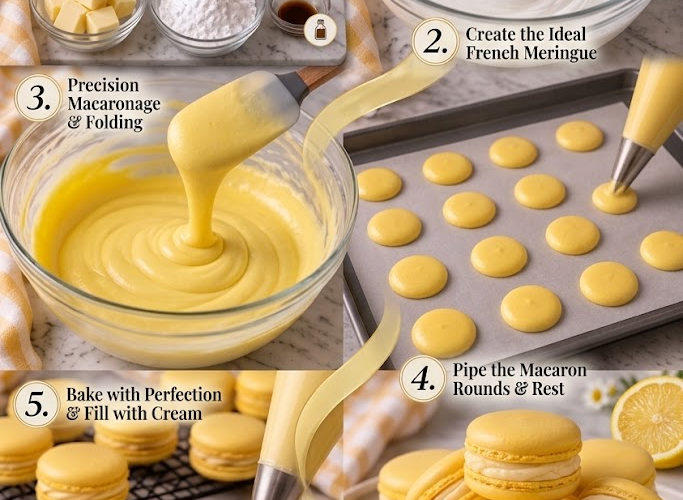
9. Perform the Macaronage
Continue folding the batter, pressing it gently against the sides of the bowl.
The finished batter should flow slowly from the spatula in a smooth ribbon.
When you lift the spatula, the batter should fall back into the bowl and disappear into itself within approximately 10–15 seconds.
Another useful test is to draw a figure eight with the batter.
If the ribbon flows smoothly without breaking, the consistency is ready.
Don’t overmix. Overmixed batter spreads too quickly and can produce thin, flat shells.
🥚 Pipe the Macarons
10. Fill a Piping Bag
Transfer the batter into a piping bag fitted with a round piping tip.
Hold the bag vertically above the prepared baking sheet.
11. Pipe the Shells
Pipe approximately 1½-inch (3.5–4cm) circles onto the baking sheet.
Stop squeezing before lifting the piping bag.
If small peaks remain, gently tap the tray against the counter.
12. Release Air Bubbles
Firmly but carefully tap each baking sheet against the counter several times.
Use a toothpick to pop any visible air bubbles.
This helps prevent hollow shells and cracks.
⏳ Rest the Shells
13. Let the Shells Dry
Leave the piped macarons at room temperature for approximately 30–60 minutes.
The exact time depends on the humidity.
They are ready when the surface feels dry and doesn’t stick to your fingertip when lightly touched.
A dry skin is essential for developing the characteristic macaron feet.
🔥 Bake the Macarons
14. Preheat the Oven
Preheat your oven to 300°F (150°C).
For the most consistent results, use an oven thermometer because many home ovens run hotter or cooler than their displayed temperature.
15. Bake
Bake one tray at a time for approximately 12–15 minutes.
The exact time depends on the size of your shells and your oven.
The shells should develop defined feet and feel set when gently touched.
They should not brown significantly.
16. Cool Completely
Remove the tray from the oven.
Allow the shells to cool completely on the baking sheet before attempting to remove them.
Once cooled, gently peel them away from the parchment or silicone mat.
Pair similar-sized shells together.
🧈 Make the Buttercream
17. Beat the Butter
Place the softened butter in a mixing bowl.
Beat for 3–5 minutes until pale, smooth, and fluffy.
Scrape down the sides of the bowl as needed.
18. Add the Powdered Sugar
Gradually add the sifted powdered sugar.
Mix on low speed initially to prevent powdered sugar from flying everywhere.
Increase the speed and beat until light and creamy.
19. Add Vanilla and Salt
Add the vanilla extract and a pinch of salt.
Beat until fully incorporated.
20. Adjust the Consistency
Add 1 tablespoon of heavy cream or milk.
Beat until fluffy.
Add another tablespoon only if needed.
The buttercream should be smooth enough to pipe but firm enough to hold its shape.
For yellow buttercream, add a small amount of yellow food coloring.
🥪 Assemble the Macarons
21. Pipe the Filling
Transfer the buttercream into a piping bag fitted with a round or star tip.
Pipe a small mound of buttercream onto the flat side of one macaron shell.
22. Sandwich the Shells
Place a matching macaron shell on top.
Gently press and twist just enough for the buttercream to spread toward the edges.
Repeat with the remaining shells and filling.
❄️ Mature the Macarons
23. Refrigerate
Place the assembled macarons in an airtight container.
Refrigerate for at least 12 hours, preferably 24 hours.
This resting period allows the filling to soften the interior of the shells slightly, creating the classic combination of a delicate exterior and chewy center.
24. Bring to Room Temperature
Remove the macarons from the refrigerator approximately 20–30 minutes before serving.
Serve at room temperature for the best texture and flavor.
⭐ Chef’s Tips
Weigh everything: Macarons are much more reliable when measured in grams rather than cups.
Sift thoroughly: Fine almond flour and powdered sugar are essential for smooth shells.
Use room-temperature egg whites: They whip more easily and consistently.
Keep equipment grease-free: Even a small amount of grease can prevent egg whites from whipping properly.
Use a thermometer: Italian meringue depends on reaching the correct syrup temperature.
Master the macaronage: The batter should flow slowly like thick lava rather than sit stiffly or run like liquid.
Don’t skip the resting period: The dry surface helps create the characteristic feet.
Bake one tray at a time: This gives you greater control over heat circulation and consistency.
Let shells cool completely: Warm shells can stick to parchment and break.
Mature before judging the texture: Freshly assembled macarons can be firmer. They develop their ideal chewy texture after resting.
🛠️ Troubleshooting
Macarons Have Cracked Tops
Possible causes include:
- Shells weren’t rested long enough
- Too much air remained in the batter
- Oven temperature was too high
- Batter was overmixed or undermixed
No Feet
Possible causes include:
- Batter was overmixed
- Shells weren’t rested sufficiently
- Meringue wasn’t whipped properly
- Oven temperature was too low
Hollow Macarons
Possible causes include:
- Excessive whipping
- Incorrect macaronage
- Oven temperature too high
- Air bubbles weren’t properly released
Macarons Spread Too Much
The batter was likely overmixed.
Next time, stop folding as soon as the batter reaches the smooth, flowing ribbon stage.
Shells Stick to the Parchment
They may be slightly underbaked.
Allow them to cool completely before removing them, and consider adding another minute or two to the baking time on your next batch.
🍋 Flavor Variations
Lemon Macarons
Add lemon zest to the buttercream and replace some of the milk with fresh lemon juice.
Raspberry Macarons
Fill the shells with raspberry buttercream or a thin layer of raspberry jam surrounded by buttercream.
Chocolate Macarons
Replace approximately 10g of almond flour with 10g unsweetened cocoa powder.
Pistachio Macarons
Add finely ground pistachios to the filling and use a pistachio buttercream.
Strawberry Macarons
Add freeze-dried strawberry powder to the buttercream for intense strawberry flavor.
Salted Caramel Macarons
Fill with buttercream and add a small dot of thick salted caramel in the center.
🍽️ Serving Suggestions
Serve these macarons alongside:
- ☕ Espresso
- ☕ Cappuccino
- 🍵 Earl Grey tea
- 🍋 Lemon tea
- 🍓 Fresh berries
- 🍫 Hot chocolate
They’re also beautiful arranged on dessert platters for birthdays, showers, afternoon tea, and celebrations.
🧊 Storage
Store assembled macarons in an airtight container in the refrigerator for up to 5 days.
Allow them to come to room temperature before serving.
❄️ Freezing
Macarons freeze exceptionally well.
Place assembled macarons in an airtight freezer-safe container and freeze for up to 2 months.
Thaw them overnight in the refrigerator, then bring them to room temperature before serving.
Unfilled shells can also be frozen separately.
🇫🇷💛 Final Result
These French Macarons have everything you want from a classic macaron: smooth glossy shells, delicate crisp edges, soft chewy centers, beautiful little feet, and a rich, creamy buttercream filling.
The Italian-meringue method takes a little care, but once you master the texture of the batter, you’ll be able to create elegant bakery-style macarons right in your own kitchen.
Delicate, colorful, buttery, and beautifully French — every bite is worth the effort. 🇫🇷💛✨