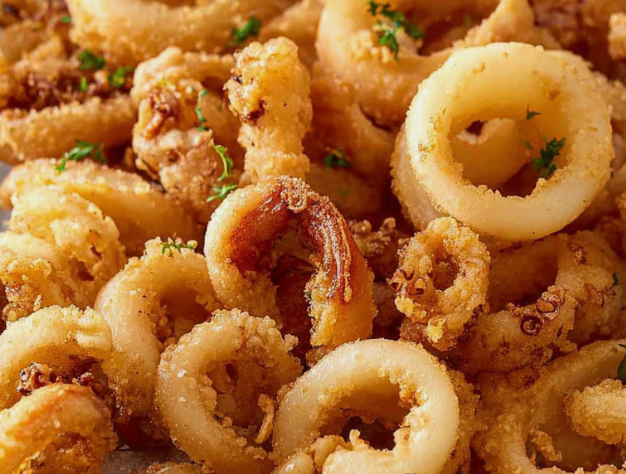
If you have ever ordered fried calamari at a typical pub or chain restaurant, you have probably been served thick, heavy, pancake-like rings where the batter slips off like a wet sleeve. That is not how they do it along the Italian coast.
True Italian calamari fritti is all about restraint and letting the seafood shine. There is no beer batter, no thick milk wash, and no heavy breadcrumbs. The squid rings hit the flour damp from cleaning, get shaken vigorously through a fine sieve until only a sheer, translucent film remains, and flash-fry in screaming-hot oil for about ninety seconds.
You end up with a shatteringly crisp, paper-thin crust that lets the natural sweetness and brininess of the squid take center stage.
The Secrets to Tender, Non-Rubbery Calamari
- The Semolina Crunch: Plain white flour gets soft quickly once the steam from the squid escapes. Mixing finely milled Italian “00” flour with durum semolina flour (semola rimacinata) provides a delicate, pebbly structure that stays crunchy long after leaving the skillet.
- The 90-Second Rule: Squid muscle is full of tight collagen fibers. Cooked rapidly in hot oil ($375\text{°F}$/ $190\text{°C}$), the exterior turns crisp while the inside stays juicy and tender. If you let it fry for three or four minutes, that collagen contracts into tight, rubbery elastic bands.
- The Sieve Shake: Dumping flour-dusted squid straight into the skillet drops loose flour into the bottom of the pan, which burns into bitter black specks and turns the oil smoky. Shaking the calamari in a wire strainer first ensures only the flour physically clinging to the squid enters the oil.
- Salt Hot, Never Raw: Never salt raw squid before dredging, or it will draw out moisture and make the coating slide off. Always dust with flaky sea salt the exact second the calamari comes out of the hot oil.
What You’ll Need
- 1 lb (450 g) cleaned calamari (tubes and tentacles, fresh or fully thawed)
- ½ cup Italian Type “00” flour (or unbleached all-purpose flour)
- ½ cup fine durum semolina flour (semola rimacinata)
- 1 teaspoon fine sea salt (for the flour dredge)
- 1 ½ to 2 cups sunflower oil (or peanut/canola oil, for frying)
- Flaky sea salt (like Maldon), for finishing
- Fresh lemon wedges, to serve
Step-by-Step Instructions
1. Cut Thick, Not Thin
Rinse the cleaned calamari tubes and tentacles under cold water.
Using a sharp chef’s knife, slice the tubes into thick rings—aim for roughly ½-inch (1.25 cm) thickness. Slicing them paper-thin makes them curl into tough little knots in the oil; thick rings hold their moisture and give you a succulent bite. Cut large tentacle clusters in half.
Leave the squid naturally damp from rinsing—do not dry it completely with paper towels, as that damp surface is the only glue you need.
2. Blend the Dusting Mix
In a wide, shallow bowl, whisk together the ½ cup 00 flour, ½ cup semolina flour, and 1 teaspoon fine salt.
3. Dredge and Shake
Toss a third of the damp squid into the flour bowl, coating every ring and crevice.
Transfer the coated squid directly into a wire colander or fine-mesh sieve set over a bowl. Vigorously shake and tap the sieve to knock off all loose flour. When done, you should still be able to clearly see the pinkish-white skin of the squid through a translucent, sheer dusting of flour.
4. Heat the Oil
Pour 1 ½ to 2 cups sunflower oil into a wide, heavy skillet or Dutch oven (the oil should be about 1 ½ inches deep).
Heat over medium-high until a deep-fry thermometer reads 375°F (190°C). (If you don’t have a thermometer, drop one ring in—it should sizzle instantly and float within two seconds).
5. Flash-Fry in Batches
- Carefully lower the sifted squid into the hot oil. Avoid overcrowding the pan so the oil temperature doesn’t drop.
- Fry for 60 to 90 seconds, stirring once with a slotted spoon or spider to keep the rings separated.
- The moment the coating turns pale-golden and crisp, scoop them out.
6. Drain and Salt Immediately
Transfer the hot calamari to a wire cooling rack set over paper towels (draining on a rack prevents steam from softening the underside).
Immediately dust with a pinch of flaky sea salt. Repeat the process with the remaining batches, making sure the oil comes back up to 375°F before each round.
7. Serve Right Away
Pile onto a platter and serve immediately with fresh lemon wedges squeezed right over the top alongside a glass of crisp white wine.
Common Kitchen Fixes
- Why did my calamari turn out rubbery? It was either left in the oil for too long or the oil wasn’t hot enough, causing the squid to boil in fat rather than flash-fry. Keep your frying window strictly under 90 seconds.
- Why did the crust turn soft? Stacking hot calamari directly on flat paper towels traps escaping steam, which softens the crust. Always drain on an elevated wire rack.
- Can I use frozen squid? Absolutely. Just let it thaw completely in the refrigerator overnight, rinse it well, and slice while still cold.