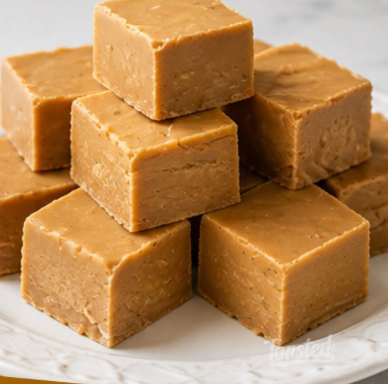
Traditional stovetop peanut butter fudge should be rich, velvety, and melt-in-your-mouth smooth—never grainy, dry, or greasy.
Achieving that signature creamy texture without chalkiness comes down to sugar crystallization chemistry: dissolving the granulated sugar completely in the milk-butter base, boiling it precisely to the soft-ball stage, and cooling it down slightly before vigorously beating in the peanut butter to form micro-crystals.
The Science of Creamy Fudge
- Controlled Sugar Crystallization: Grainy fudge happens when sugar crystals form too fast and grow too large. Boiling sugar, milk, and butter dissolves the sucrose. When you take it off the heat and let it cool slightly before beating, you force millions of microscopic crystals to form simultaneously, creating a silky, melt-in-your-mouth texture.
- Peanut Butter as a Fat Emulsion: Standard commercial creamy peanut butter (like Jif or Skippy) contains hydrogenated vegetable oils and emulsifiers that stabilize the fudge and prevent oil separation. Natural “stir” peanut butters have free-floating oils that can split under heat, leaving the fudge oily and crumbly.
- The Role of Salt & Vanilla: Salt cuts right through the intense sweetness of the sugar, while vanilla extract rounds out the roasted, nutty profile of the peanuts.
Complete Ingredients List
- 2 cups (400 g) granulated white sugar
- ½ cup (120 ml) whole milk (or evaporated milk)
- ½ cup (1 stick / 115 g) unsalted butter, cut into pieces
- 1 cup (250 g) creamy commercial peanut butter
- 1 teaspoon pure vanilla extract
- ¼ teaspoon fine sea salt
Step-by-Step Master Instructions
1. Prepare the Pan
Line an 8×8-inch (20×20 cm) square baking dish with parchment paper or aluminum foil, leaving an overhang on the sides to use as handles. Lightly grease the paper with butter or non-stick spray.
2. Dissolve and Boil the Base
- In a medium, heavy-bottomed saucepan, combine the 2 cups sugar, ½ cup milk, ½ cup butter, and ¼ tsp salt.
- Set over medium heat and stir continuously with a wooden spoon until the butter melts and the sugar granules are completely dissolved.
- Bring the mixture to a full rolling boil.
3. The Precision Boil (Soft-Ball Stage)
Once boiling, stop stirring. Let the mixture boil undisturbed for 2 ½ to 3 minutes (or until a candy thermometer reads 234°F–238°F / 112°C–114°C, the soft-ball stage).
No Thermometer? (Cold Water Test): Drop a small spoonful of syrup into a glass of ice-cold water. Reach in and roll it between your fingers—it should form a soft, pliable ball that flattens when pressed.
4. Beat in the Flavor & Emulsify
- Remove the saucepan immediately from the heat. Let it sit undisturbed for 2 minutes to cool slightly.
- Add the 1 cup peanut butter and 1 tsp vanilla extract directly to the hot syrup.
- Beat vigorously with a wooden spoon or heat-proof spatula for 2 to 3 minutes.
- Visual Cue: The mixture will transform from a glossy, loose syrup into a thick, satin-matte paste that starts to hold ripples and pull away slightly from the sides of the pan.
5. Pour and Set
- Immediately scrape the warm fudge into the prepared square dish, spreading it into an even layer with an offset spatula.
- Let the fudge sit at room temperature for 2 to 3 hours (or in the refrigerator for 45 minutes to 1 hour) until firm to the touch.
6. Slice and Serve
Lift the fudge block out of the pan using the parchment paper handles. Place it on a cutting board and slice into neat 1-inch to 1.5-inch squares using a long, sharp chef’s knife.
Baker’s Troubleshooting & Precision Matrix
| Issue | Root Cause | How to Fix Next Time |
| Fudge turned out grainy or gritty | Boiled with sugar crystals stuck to the pan sides, or stirred too much while boiling. | Brush the sides of the pan with a wet pastry brush during boiling; do not stir while boiling. |
| Fudge is too soft or won’t set | Didn’t reach $234\text{°F}$ (under-boiled), leaving too much water in the mixture. | Use a digital candy thermometer to ensure it reaches true soft-ball stage ($234\text{°F}$–$238\text{°F}$). |
| Fudge is dry, crumbly, or hard | Over-boiled past soft-ball stage, or beaten too long before pouring into the pan. | Pull off heat immediately at $236\text{°F}$; pour into pan the second the sheen turns matte. |
| Oil separated on top | Used natural “separated” peanut butter, or added peanut butter while syrup was boiling. | Use standard emulsified commercial peanut butter; let syrup rest 2 minutes off heat before adding. |
Storage & Freshness
- Room Temperature: Store fudge in an airtight container with layers separated by parchment paper for up to 2 weeks.
- Refrigeration: Keeps for up to 4 weeks in the fridge.
- Freezing: Wrap the entire block or individual squares tightly in plastic wrap and aluminum foil, then store in a freezer bag for up to 3 months. Thaw in the refrigerator overnight before slicing and serving.