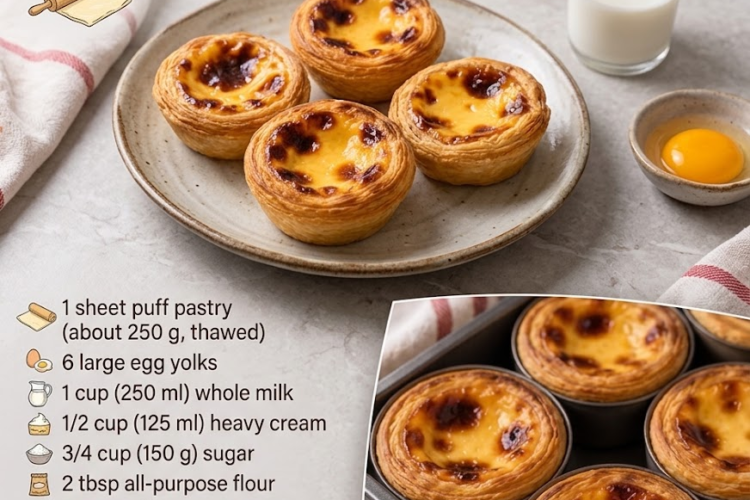
🥧🇵🇹 Portuguese Egg Tarts (Pastéis de Nata)
Crisp, flaky, buttery pastry filled with a rich, creamy egg custard and baked until the tops develop those irresistible golden-brown caramelized spots.
These homemade Portuguese Egg Tarts, also known as Pastéis de Nata, are one of Portugal’s most beloved pastries. The contrast between the shattering puff pastry and silky custard makes every bite incredibly satisfying.
A light dusting of cinnamon adds a warm, traditional finishing touch.
⏱️ Recipe Information
Prep Time: 25 minutes
Chill Time: 15 minutes
Bake Time: 15–20 minutes
Total Time: About 1 hour
Yield: 12 egg tarts
Difficulty: Intermediate
Method: Oven-Baked
Pan: Standard 12-cup muffin tin
🛒 Ingredients
🥐 For the Pastry
- 1 sheet puff pastry — about 250g, thawed
- A little all-purpose flour, for dusting if needed
🥚 For the Custard
- 6 large egg yolks
- 1 cup (250ml) whole milk
- ½ cup (125ml) heavy cream
- ¾ cup (150g) granulated sugar
- 2 tablespoons all-purpose flour
- 1 teaspoon vanilla extract
- ¼ teaspoon salt
- ½ teaspoon ground cinnamon, optional
For Finishing
- Ground cinnamon, for dusting
- Powdered sugar, optional
👩🍳 Procedure
🥐 Prepare the Puff Pastry
1. Prepare the Pastry
Lightly flour your work surface.
Unroll the thawed puff pastry and gently smooth it out.
Starting from one short end, tightly roll the pastry into a compact log.
Roll it as evenly and tightly as possible.
2. Chill the Pastry
Wrap the pastry log in plastic wrap.
Refrigerate for approximately 15–20 minutes.
This firms up the butter and makes the pastry easier to portion.
3. Cut Into Portions
Unwrap the chilled pastry log.
Cut it into 12 equal pieces.
Place each piece cut-side down in a muffin cup.
4. Shape the Pastry Cups
Dip your fingertips lightly in water.
Starting from the center of each pastry piece, press outward and upward to form a thin pastry cup.
The pastry should extend slightly above the rim of each muffin cup.
Try to keep the bottom reasonably thin while maintaining a slightly thicker rim.
Place the muffin tin in the refrigerator while you prepare the custard.
🥚 Make the Custard
5. Combine the Flour and Sugar
In a medium saucepan, whisk together the granulated sugar and flour.
This helps distribute the flour evenly and reduces the chance of lumps.
6. Add the Milk and Cream
Gradually whisk in the whole milk and heavy cream.
Continue whisking until the mixture is smooth.
7. Cook the Custard Base
Place the saucepan over medium heat.
Cook, whisking constantly, until the mixture becomes slightly thickened.
Do not allow it to reach a heavy boil.
Remove from the heat.
8. Add the Flavorings
Stir in the vanilla extract, salt, and optional cinnamon.
Allow the mixture to cool for several minutes.
It should be warm rather than piping hot before adding the egg yolks.
9. Add the Egg Yolks
Place the egg yolks in a separate bowl.
Slowly whisk a small amount of the warm milk mixture into the yolks to temper them.
Gradually add more of the warm mixture while whisking continuously.
Once tempered, pour the yolk mixture back into the saucepan.
Whisk until smooth.
10. Strain the Custard
For an especially smooth filling, pour the custard through a fine-mesh sieve into a measuring jug or bowl.
This removes any tiny bits of cooked egg or flour.
🔥 Assemble the Egg Tarts
11. Preheat the Oven
Preheat your oven to 475°F (245°C).
Portuguese egg tarts traditionally bake at a very high temperature, which helps the pastry puff while creating the characteristic caramelized custard surface.
If your oven does not safely reach 475°F, use the highest temperature recommended by your oven manufacturer.
12. Fill the Pastry Cups
Remove the muffin tin from the refrigerator.
Carefully pour the custard into each pastry shell.
Fill each cup approximately ¾ full.
Do not fill completely to the rim, as the custard will puff slightly during baking.
🥧 Bake
13. Bake Until Caramelized
Place the muffin tin in the hot oven.
Bake for approximately 15–20 minutes.
The pastry should be deeply golden and crisp, while the custard should be set around the edges with a slight wobble in the center.
The tops should develop dark golden or caramelized spots.
These spots are part of the signature appearance of Pastéis de Nata.
14. Cool
Remove the tarts from the oven.
Allow them to cool in the muffin tin for approximately 5–10 minutes.
The custard will continue to set as it cools.
15. Remove From the Tin
Carefully loosen the edges with a thin knife or small offset spatula.
Transfer the tarts to a wire rack.
Allow them to cool until warm or at room temperature.
✨ Finish and Serve
16. Add Cinnamon
Dust the tops lightly with ground cinnamon.
For extra sweetness, you can also add a very small dusting of powdered sugar.
Serve warm or at room temperature.
⭐ Chef’s Tips
Keep the pastry cold: Cold puff pastry produces better layers and a flakier crust.
Roll tightly: A compact pastry log creates distinct layers when baked.
Don’t make the pastry cups too thick: A thin pastry shell gives you the ideal crisp-to-custard ratio.
Temper the egg yolks: Slowly adding the warm liquid prevents the yolks from scrambling.
Strain the custard: This produces an exceptionally smooth and silky filling.
Use high heat: The intense heat is what helps create the characteristic caramelized spots on the custard.
Don’t overfill: Leave room for the custard to rise slightly.
Don’t overbake the custard: The center should still have a gentle wobble when the tarts come out of the oven.
Serve fresh: Pastéis de Nata are at their best on the day they’re baked, while the pastry is still crisp.
🍮 Easy Variations
🍋 Lemon Egg Tarts
Add 1 teaspoon finely grated lemon zest to the custard.
🍊 Orange Egg Tarts
Add 1 teaspoon orange zest and a tiny pinch of cinnamon.
🌿 Cinnamon Custard Tarts
Increase the cinnamon slightly and dust the finished tarts generously with cinnamon before serving.
🍫 Chocolate Egg Tarts
Add a small amount of melted dark chocolate to the cooled custard for a richer variation.
🥥 Coconut Egg Tarts
Replace a portion of the heavy cream with coconut cream and add a little toasted coconut as a garnish.
☕ Serving Suggestions
Portuguese Egg Tarts are particularly delicious served warm alongside:
- Espresso
- Strong black coffee
- Portuguese-style coffee
- Earl Grey tea
- Black tea
- Fresh berries
For the classic experience, serve them warm with a light dusting of cinnamon.
🧊 Storage
Store cooled egg tarts in an airtight container in the refrigerator for up to 3 days.
The pastry will gradually soften as it sits.
For the best texture, reheat before serving.
🔥 Reheating
Place refrigerated tarts in a 375°F (190°C) oven for approximately 5–8 minutes.
Alternatively, use an air fryer at 350°F (175°C) for 3–5 minutes.
Allow them to cool for a few minutes before eating.
Avoid microwaving if possible, as it can make the pastry soft and chewy.
🥧🇵🇹 Final Result
These Portuguese Egg Tarts (Pastéis de Nata) feature flaky, buttery pastry wrapped around a silky vanilla custard that bakes into a beautifully caramelized golden top.
The pastry shatters delicately with each bite while the creamy custard melts in your mouth.
Crispy, creamy, caramelized, and absolutely irresistible—Portugal’s iconic little custard tart made at home. 🥧🇵🇹✨