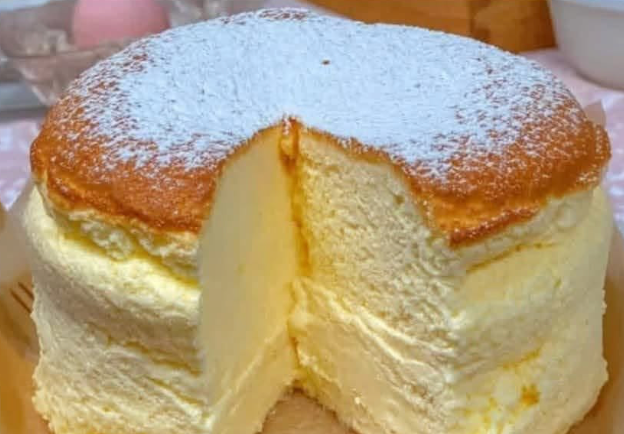
If you’ve ever scrolled through pastry videos and stopped dead in your tracks watching a cake gently wobble and jiggle like a bowl of custard, you’ve seen Japanese cotton cloud cheesecake.
It is one of the most famous bakes in the world for a reason. It sits right in the sweet spot between a rich, tangy New York cheesecake and an airy, delicate French soufflé. When you cut into it, you hear that distinct airy whisper, and each bite practically evaporates on your tongue with a silky, velvety cream cheese finish.
The viral idea of “just throwing everything into a blender and baking” sounds amazing, but doing that with whole eggs creates a dense, rubbery custard rather than a cloud. The blender is the ultimate secret weapon here, but for a different reason: it whips the stubborn cream cheese, butter, warm milk, and yolks into a lump-free, silky batter in literally twenty seconds, leaving you with only one simple manual task—whipping the egg whites into a soft meringue to provide that signature lift.
Let’s walk through the exact mechanics of making one at home that stays tall, doesn’t crack, and gives you that perfect golden dome.
The Science Behind That Signature Wobble
Getting this cake right isn’t about complicated pastry skills—it comes down to managing temperature and how you whip your air:
- The Blender Shortcut (Fat Emulsification): Cream cheese and cold butter are notorious for clumping when you whisk them by hand. Tossing the softened cream cheese, butter, warm milk, and egg yolks into a blender blitzes the fats into a smooth emulsion without overworking the mixture.
- Low-Protein Flour Blend (Cake Flour + Cornstarch): Regular all-purpose flour has too much protein, which builds gluten networks that make cakes sturdy and chewy. By using low-protein cake flour paired with pure cornstarch, we keep the gluten minimal. The cake holds its height while maintaining a melt-in-your-mouth crumb.
- The Soft-Peak Rule for Egg Whites: This is where most bakers run into trouble. If you whip egg whites until they are stiff, dry, and rigid, the air bubbles inside expand too aggressively in the oven. The cake puffs up like a balloon, splits wide open across the top, and then deflates into a sunken crater the moment it cools. Whipping the whites only to soft peaks (where the tip droops gently like a bird’s beak) creates tiny, elastic bubbles that expand evenly and gently.
- The Steam Bath (Bain-Marie): Baking the cake pan inside a deep tray of hot water keeps the surrounding heat capped around 212°F (100°C). That humid, low-temperature environment ensures the outer edges don’t scorch or curdle before the center has time to set.
What You’ll Need
For the Blender Batter:
- 200 g (7 oz) cream cheese, softened to room temperature
- 50 g (3 tablespoons) unsalted butter, softened
- 100 ml (7 tablespoons / a little under ½ cup) whole milk, warmed slightly (about lukewarm, 100°F)
- 4 large egg yolks (save the whites in a spotlessly clean, grease-free bowl)
- 40 g (⅓ cup) cake flour, sifted
- 10 g (1 tablespoon) cornstarch
- 1 teaspoon pure vanilla extract
- ½ teaspoon fresh lemon juice (brings out that cheesecake tang)
For the Soft-Peak Meringue:
- 4 large egg whites, cold
- 70 g (⅓ cup) granulated white sugar
- ½ teaspoon lemon juice or cream of tartar (stabilizes the egg whites)
For the Finish:
- 2 tablespoons powdered sugar, for dusting the top
Step-by-Step Instructions
1. Prep the Pan and Water Bath
Preheat your oven to 300°F (150°C) with the rack placed in the lower-middle position.
Line the bottom and sides of a 6-inch or 7-inch round springform pan (or solid cake pan) with parchment paper. Cut the parchment paper for the sides about 2 inches taller than the rim of the pan—this paper collar supports the cake as it climbs.
Waterproofing Tip: If using a springform pan with a removable base, wrap the bottom and sides in 2 to 3 layers of heavy-duty aluminum foil to keep the water bath from leaking into your batter.
2. Blend the Base
Add the 200 g softened cream cheese, 50 g softened butter, 100 ml warm milk, 4 egg yolks, 1 tsp vanilla, and ½ tsp lemon juice into your blender.
Blend on medium speed for 20 seconds until smooth, creamy, and completely uniform.
Add the 40 g cake flour and 10 g cornstarch. Pulse 3 or 4 times just until the dry starches are incorporated. Pour the mixture through a fine-mesh strainer into a large bowl to catch any stray flour pockets or bubbles.
3. Whip the Soft-Peak Meringue
In a clean, dry glass or metal bowl, combine the 4 cold egg whites and ½ tsp lemon juice (or cream of tartar).
Start beating on medium-low speed with a hand mixer until foamy. Once foamy, begin sprinkling in the 70 g granulated sugar one spoonful at a time while increasing the speed to medium.
Beat for about 3 to 4 minutes until soft peaks form. When you lift the beaters out, the meringue should hold its shape with a tip that bends over softly. Stop immediately—do not whip to stiff, glossy peaks!
4. The Gentle Three-Stage Fold
- Take one-third of your whipped meringue and whisk it gently into the cream cheese batter to loosen the mixture.
- Add the second third of the meringue and fold gently with a silicone spatula using sweeping, circular motions from the bottom of the bowl upward.
- Pour the lightened batter into the bowl with the remaining meringue. Fold gently until the entire batter is a uniform pale-yellow color with no white streaks left.
5. Pour and Drop
Pour the batter into your prepared pan from about 6 inches above the counter (this breaks up any large air pockets as it falls).
Pick the pan up and drop it flat against the countertop twice to bring small trapped bubbles to the surface. Smooth the top with a toothpick or spatula.
6. The Low and Slow Steam Bake
Place the wrapped cake pan inside a deep roasting pan or baking dish. Pour hot (not boiling) tap water into the roasting pan until it reaches about 1 inch up the sides of your cake pan.
- Bake at 300°F (150°C) for 60 minutes.
- Lower the oven temperature to 230°F (110°C) and bake for an additional 15 to 20 minutes until the top is golden-brown and the center wobbles gently like gelatin when the pan is nudged.
7. The Gradual Oven Cool-Down
Turn the oven off completely. Prop the oven door open about an inch with the handle of a wooden spoon and let the cake sit inside the cooling oven for 15 to 20 minutes.
This slow temperature drop keeps the delicate steam pockets inside the cake from collapsing suddenly when hit with cold room-temperature air.
Remove the cake from the water bath, peel down the parchment paper collar, and dust the warm golden dome with powdered sugar.
Troubleshooting Common Mishaps
- Why did my cheesecake crack on top? The oven was running too hot, or the meringue was whipped to stiff peaks. Keep the meringue at soft peaks and consider dropping your oven temperature by 10°F to 15°F next time.
- Why did it sink into a flat disc after cooling? The cake cooled down too fast in a drafty kitchen, or it was pulled out of the oven before the center structure fully set. Let the cake rest inside the propped-open, turned-off oven for the full 20 minutes.
- Why is the bottom layer dense or wet? Either water leaked through the foil into the pan, or the meringue wasn’t folded evenly into the batter, allowing the heavier cream cheese mixture to sink to the bottom during baking.
How to Serve It
- Warm & Jiggly: Slice into it within 20 minutes of cooling for that famous, cloud-like wobble and ultra-soft, warm soufflé texture.
- Chilled & Velvety: Pop the cooled cake in the fridge for 4 hours before slicing. The chilled dairy condenses into an impossibly smooth, melt-in-your-mouth mousse cake that tastes even richer with fresh berries on the side.