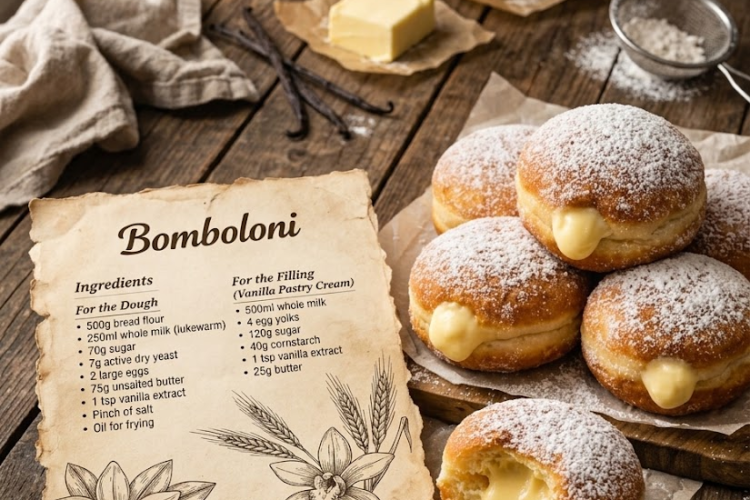
🍩 Italian Bomboloni – Soft, Fluffy Donuts with Creamy Vanilla Custard
These Italian Bomboloni are irresistibly soft, pillowy, golden donuts filled with silky homemade vanilla pastry cream and coated in a delicate layer of sugar. With their tender, buttery dough and rich custard center, these classic Italian treats taste like something straight from a neighborhood bakery in Italy!
Made with an enriched yeast dough, Bomboloni have a light interior, a beautifully golden exterior, and a generous filling of smooth vanilla custard. They’re delicious served fresh for breakfast, afternoon coffee, weekend brunch, or as a special homemade dessert.
The secret to perfect Bomboloni is allowing the dough to rise properly, frying at the right temperature, and filling the donuts generously while they’re still fresh.
Recipe Information
- Prep Time: 35 minutes
- First Rising Time: 1–1½ hours
- Second Rising Time: 45–60 minutes
- Cook Time: 20–25 minutes
- Cooling and Filling Time: 30 minutes
- Total Time: Approximately 3½–4 hours
- Yield: 14–16 Bomboloni
- Course: Breakfast, Dessert, Sweet Snack
- Cuisine: Italian
- Difficulty: Moderate
Ingredients
For the Bomboloni Dough
- 500 g bread flour
- 250 ml whole milk, lukewarm
- 70 g granulated sugar
- 7 g active dry yeast
- 2 large eggs, at room temperature
- 75 g unsalted butter, softened
- 1 teaspoon vanilla extract
- 1 pinch salt
- Neutral frying oil, such as sunflower, canola, or vegetable oil
- Granulated sugar, for coating
For the Vanilla Pastry Cream Filling
- 500 ml whole milk
- 4 large egg yolks
- 100 g granulated sugar
- 40 g cornstarch (cornflour)
- 1 teaspoon vanilla extract
- 25 g unsalted butter
- A small pinch of salt
For Finishing
- Extra granulated sugar for rolling the warm donuts
- A little powdered sugar, optional
- Extra vanilla pastry cream, if desired for generous filling
Instructions
Step 1: Activate the Yeast
Pour the lukewarm milk into a small bowl. It should feel comfortably warm, not hot, ideally around 35–40°C (95–104°F).
Add the active dry yeast and approximately 1 teaspoon of the measured sugar. Stir gently and let it stand for 5–10 minutes, until the mixture looks foamy.
If the mixture does not foam, the yeast may be inactive or the milk may have been too hot or too cold. Check the yeast before continuing.
Step 2: Combine the Dough Ingredients
In a large mixing bowl, combine the bread flour, remaining sugar, and salt.
Add the eggs, vanilla extract, and activated yeast mixture. Mix with a wooden spoon or dough hook until a rough dough forms.
The dough will initially feel sticky and slightly uneven. This is normal for an enriched dough.
Step 3: Knead Until Smooth
Knead the dough for approximately 8–10 minutes by hand, or 5–7 minutes using a stand mixer fitted with a dough hook.
Gradually add the softened butter in small pieces, allowing each addition to become incorporated before adding more.
Continue kneading until the dough becomes smooth, elastic, and slightly tacky. It should stretch without tearing immediately, although it may still feel softer than ordinary bread dough.
Avoid adding too much extra flour. A soft dough helps produce light, fluffy Bomboloni.
Step 4: Let the Dough Rise
Shape the dough into a ball and place it in a lightly greased bowl.
Cover with plastic wrap or a clean kitchen towel and leave it in a warm, draft-free location for 1–1½ hours, or until approximately doubled in size.
The rising time will depend on the temperature of your kitchen. Look at the dough’s growth rather than relying only on the clock.
Step 5: Prepare the Vanilla Pastry Cream
While the dough rises, prepare the filling.
In a medium saucepan, heat the milk over medium heat until steaming and just beginning to show small bubbles around the edges. Do not allow it to boil vigorously.
In a separate heatproof bowl, whisk together the egg yolks, sugar, cornstarch, and salt until smooth and pale.
Gradually pour about one-third of the hot milk into the egg mixture, whisking constantly to temper the yolks and prevent them from scrambling.
Pour the tempered egg mixture back into the saucepan with the remaining milk.
Step 6: Cook the Pastry Cream
Place the saucepan over medium-low heat and whisk continuously, reaching the bottom and corners of the pan.
After several minutes, the mixture will begin to thicken. Once it bubbles gently, continue whisking and cook for approximately 30–60 seconds to ensure the cornstarch is fully cooked.
Remove the saucepan from the heat. Stir in the vanilla extract and butter until the cream is smooth and glossy.
Transfer the pastry cream to a shallow bowl and press food-safe plastic wrap directly against its surface to prevent a skin from forming.
Allow it to cool briefly, then refrigerate until completely cold, at least 1 hour. Keep the custard refrigerated until you are ready to fill the donuts.
Step 7: Shape the Bomboloni
Once the dough has doubled in size, gently press it to release the larger air bubbles.
Transfer it to a lightly floured work surface and roll it to approximately 1.5 cm (⅝ inch) thick.
Using a round cutter approximately 7–8 cm (2¾–3 inches) wide, cut out rounds. Gather the scraps gently, allow them to rest for a few minutes, and cut additional rounds.
Place the dough rounds on small squares of parchment paper or on a lightly floured tray, leaving space between them.
Aim for approximately 14–16 pieces, depending on the size of your cutter.
Step 8: Allow the Donuts to Rise Again
Cover the shaped rounds loosely with a clean kitchen towel.
Leave them to rise for 45–60 minutes, or until visibly puffed and light. They should look airy but still retain their shape when handled carefully.
Avoid letting them overproof, as excessively risen dough can collapse or absorb too much oil during frying.
Step 9: Heat the Frying Oil
Pour oil into a deep, heavy-bottomed pot to a depth of approximately 5–7 cm (2–3 inches), leaving plenty of room at the top.
Heat the oil to 170–175°C (340–350°F), using a kitchen thermometer for accuracy.
Keep the temperature steady throughout frying. Oil that is too cool can make the donuts greasy, while oil that is too hot can brown the exterior before the centers cook properly.
Keep water away from the hot oil, and never leave it unattended.
Step 10: Fry Until Golden
Carefully lower a few dough rounds into the oil, working in small batches.
Fry for approximately 1½–2½ minutes per side, turning gently with a slotted spoon or chopsticks, until both sides are evenly golden brown.
The exact time depends on the size and thickness of the donuts. Check the first batch by opening one to ensure the center is cooked through, then adjust the cooking time if necessary.
Transfer the cooked Bomboloni to a wire rack or paper towel-lined tray to drain briefly.
Repeat with the remaining dough, allowing the oil to return to the correct temperature between batches.
Step 11: Coat the Donuts in Sugar
While the Bomboloni are still warm, roll each one in a bowl of granulated sugar until coated on all sides.
The sugar adheres best while the exterior is still slightly warm and fresh from frying.
Place the coated donuts on a clean tray and allow them to cool enough to handle comfortably before filling.
Step 12: Prepare the Pastry Cream for Filling
Remove the chilled vanilla pastry cream from the refrigerator.
Whisk it briefly until smooth and creamy. Transfer it to a piping bag fitted with a small round filling tip.
If the custard is too firm to pipe, whisk it until smooth. Avoid adding too much milk, as the filling should remain thick enough to stay inside the donuts.
Step 13: Fill the Bomboloni
Use the tip of a small knife or skewer to make a hole in the side of each donut.
Insert the piping tip into the opening and gently squeeze the pastry cream inside. You should feel the donut become slightly heavier and fuller as the filling is added.
Fill each Bomboloni generously without forcing the cream through the sides.
Repeat with the remaining donuts.
Step 14: Finish and Serve
Arrange the filled Bomboloni on a serving platter. If desired, dust them lightly with powdered sugar for a beautiful bakery-style finish.
Serve fresh while the donuts are soft and fluffy and the vanilla custard is cool and creamy.
Chef’s Tips for Perfect Italian Bomboloni
- Measure the flour accurately: Too much flour can make the dough stiff and produce dense donuts.
- Use soft, pliable dough: The enriched dough should be slightly tacky. Resist adding unnecessary flour while kneading.
- Let the dough rise fully: Proper fermentation creates the light, airy texture Bomboloni are known for.
- Handle the shaped dough gently: Pressing or stretching the rounds too firmly can deflate them.
- Monitor the oil temperature: Aim for 170–175°C (340–350°F) for a golden crust and a properly cooked center.
- Fry in small batches: Too many donuts can lower the oil temperature and lead to greasy results.
- Coat while warm: The sugar adheres best immediately after frying.
- Chill the custard thoroughly: Cold pastry cream is easier to pipe and holds its shape inside the donuts.
- Fill generously: The creamy vanilla center is one of the defining features of Bomboloni.
Delicious Filling Variations
🍫 Chocolate Pastry Cream
Replace a portion of the milk with chocolate or add 80–100 g chopped dark chocolate to the hot pastry cream after removing it from the heat. Stir until smooth.
🍓 Strawberry Cream
Fill the donuts with chilled pastry cream mixed with a small amount of thick strawberry purée or strawberry jam.
🍯 Hazelnut Chocolate Filling
Use chocolate-hazelnut spread as a quick alternative to pastry cream, or combine it with a little cooled pastry cream for a softer filling.
🍋 Lemon Custard
Add finely grated lemon zest to the milk as it heats, then strain before combining with the egg mixture for a fresh citrus variation.
☕ Coffee Cream
Dissolve 1–2 teaspoons instant espresso powder in the warm milk before making the pastry cream.
🍮 Diplomat Cream
For an especially light filling, gently fold some freshly whipped cream into the completely chilled pastry cream. Keep the finished cream refrigerated and fill the donuts shortly before serving.
Make-Ahead Instructions
The vanilla pastry cream can be prepared a day in advance. Cover it directly on the surface and refrigerate until needed.
The dough can also be prepared ahead and refrigerated after its first rise. Cover it tightly and chill it, then allow it to warm slightly before shaping and completing the second rise.
For the best texture, fry and fill the Bomboloni on the day you plan to serve them. Freshly fried donuts are especially soft and delicious.
Storage Instructions
Room Temperature: Unfilled, sugar-coated donuts are best eaten on the day they are fried. Store them in a covered container in a cool place for a short period.
Refrigerator: Once filled with pastry cream, store the Bomboloni in an airtight container in the refrigerator and consume within 2–3 days. The donuts may gradually soften as they absorb moisture from the filling.
Freezing: For best results, freeze the fried donuts before filling. Allow them to cool completely, then store them in a freezer-safe container for up to 2 months for best quality. Thaw and warm gently, then fill with freshly prepared pastry cream.
Food safety: Because the filling contains milk and egg yolks, keep filled Bomboloni refrigerated when not serving. Do not leave them at room temperature for more than 2 hours, or more than 1 hour when temperatures exceed 32°C (90°F).
Frequently Asked Questions
Why are my Bomboloni dense?
The dough may not have risen enough, too much flour may have been added, or the donuts may have been overworked during shaping. Keep the dough soft and allow adequate rising time.
Why are my donuts raw in the center?
The oil may be too hot, causing the exterior to brown before the inside cooks. Maintain the temperature around 170–175°C (340–350°F), and adjust the frying time according to the size of the donuts.
Can I bake Bomboloni instead of frying them?
Yes, although the texture will be more similar to a soft filled bun than a traditional Bombolone. Brush the risen dough rounds lightly with milk or egg wash and bake at 180°C (350°F) until golden and cooked through, approximately 12–18 minutes depending on size. Brush with melted butter and roll in sugar while warm.
Can I use instant yeast instead of active dry yeast?
Yes. You can generally use the same weight of instant yeast. Mix it directly into the flour rather than activating it in the milk, and continue with the recipe.
Why is my pastry cream lumpy?
The eggs may have cooked too quickly, or the cream may not have been whisked continuously. Whisk constantly while gradually adding the warm milk. If small lumps develop, pass the finished pastry cream through a fine-mesh sieve while it is still warm.
Can I fill Bomboloni with jam?
Absolutely! Strawberry, raspberry, apricot, or cherry jam makes a delicious alternative to vanilla pastry cream.
Can I prepare Bomboloni for a bakery or small business?
Yes. The recipe can be portioned consistently for selling, but filled donuts containing custard must be kept properly chilled and handled according to local food-safety requirements.
Serving Suggestions
Serve these Italian Bomboloni with:
- Espresso or cappuccino
- Hot chocolate
- Fresh berries
- Extra vanilla pastry cream
- Chocolate dipping sauce
- A light dusting of powdered sugar
For a dessert platter, prepare a selection with vanilla custard, chocolate cream, and strawberry filling. The different flavors look beautiful arranged together and make the treats especially appealing for parties and celebrations.
Final Result
These Homemade Italian Bomboloni are golden, soft, and pillowy, with a delicate sugar coating and a rich, silky vanilla custard center. Their buttery dough, fragrant vanilla, and creamy filling create a bakery-style treat that feels both indulgent and comforting.
The secret to success: develop a soft, elastic dough, allow it to rise properly, fry at the correct temperature, and fill the donuts generously with thoroughly chilled pastry cream. Serve fresh for the most delicious homemade Bomboloni!