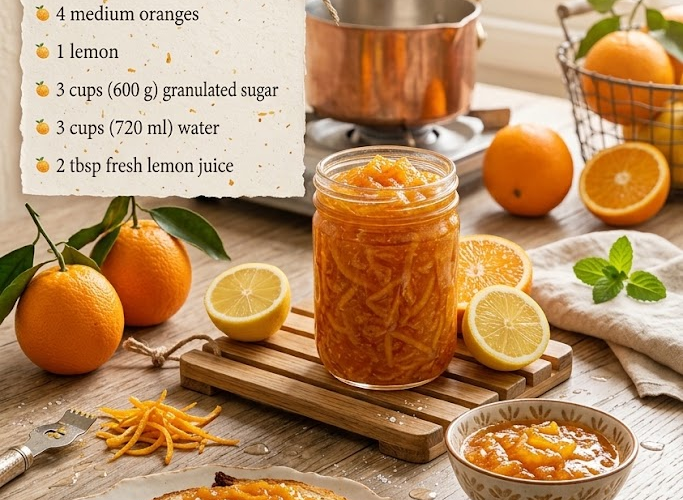
🍊 Homemade Orange Marmalade
Bright, citrusy, sweet, and slightly bitter in the best way, this Homemade Orange Marmalade is made with fresh oranges, lemon, sugar, and water. It’s delicious spread over toast, biscuits, scones, pancakes, or used in cakes and glazes.
⏱ Recipe Information
Prep Time: 25 minutes
Cook Time: 60–90 minutes
Total Time: About 2 hours
Yield: Approximately 3–4 cups
Difficulty: Medium
🛒 Ingredients
- 4 medium oranges
- 1 lemon
- 3 cups (600 g) granulated sugar
- 3 cups (720 ml) water
- 2 tablespoons fresh lemon juice
Instructions
🍊 1. Prepare the Citrus
Wash and scrub the oranges and lemon thoroughly.
Pat them dry.
Using a sharp knife, trim off the ends of the oranges.
Cut the oranges in half lengthwise, then slice them very thinly.
Remove any seeds and reserve them separately.
Repeat with the lemon, removing the seeds.
Don’t discard the citrus seeds. They contain natural pectin and can help the marmalade set.
🔪 2. Slice the Peel
Stack a few orange slices and cut them into thin strips if you prefer a more traditional marmalade texture.
You can make the strips very fine or slightly wider depending on how chunky you like your marmalade.
💧 3. Soak the Citrus
Place the sliced oranges and lemon into a large heavy-bottomed saucepan.
Add the 3 cups of water.
Cover and let the citrus soak for at least 4 hours, preferably overnight in the refrigerator.
This softens the peel and helps release the natural pectin.
Shortcut: If you’re pressed for time, you can skip the overnight soak, but the peel may take longer to become tender during cooking.
🍊 4. Cook the Citrus
Place the saucepan over medium-high heat.
Bring the mixture to a boil.
Reduce the heat to a steady simmer.
Cook uncovered for approximately 30–45 minutes, stirring occasionally, until the citrus peel is very tender.
The liquid should reduce somewhat.
🍬 5. Add the Sugar
Add the 600 g granulated sugar.
Stir until the sugar has completely dissolved.
Add the 2 tablespoons fresh lemon juice.
Bring the mixture back to a boil.
🔥 6. Cook Until the Marmalade Sets
Continue cooking over medium heat for approximately 20–40 minutes, stirring occasionally.
The mixture will become darker, thicker, and glossy.
As it approaches setting point, watch it carefully because it can scorch quickly.
Don’t rely only on how thick it looks while boiling. Marmalade becomes significantly thicker as it cools.
❄️ 7. Test the Setting Point
Place a small plate in the freezer before you begin cooking the marmalade.
When you think the marmalade is ready, place a teaspoonful onto the chilled plate.
Return the plate to the freezer for about 1 minute.
Push the marmalade gently with your finger.
If it wrinkles slightly and holds its shape, it’s ready.
If it remains very runny, continue cooking for another 3–5 minutes and test again.
Optional Thermometer Method
If using a candy or kitchen thermometer, marmalade generally reaches its setting point around 220°F (104°C), although altitude and other factors can affect the exact temperature.
🫙 8. Rest the Marmalade
Remove the saucepan from the heat.
Let the marmalade stand for approximately 5–10 minutes.
This allows the peel to distribute more evenly instead of floating entirely at the top.
🫙 9. Fill the Jars
Pour the hot marmalade into clean, sterilized jars.
Leave approximately ¼ inch (6 mm) of headspace.
Wipe the rims clean and seal according to your preferred canning method.
Allow the jars to cool.
🍞 10. Serve
Once cooled and set, spread the marmalade over:
- Toast
- English muffins
- Scones
- Biscuits
- Pancakes
- Waffles
- Croissants
It also makes a wonderful glaze for cakes, roasted meats, and pastries.
⭐ Chef’s Tips
Slice the Peel Thinly
Thin slices create a more delicate texture and make the marmalade easier to spread.
Don’t Rush the First Cook
The citrus peel needs to become completely tender before adding the sugar.
Add Sugar After Softening the Peel
Sugar can make citrus peel firm, so cooking the peel in water first helps ensure a tender finished texture.
Don’t Overcook
Overcooked marmalade can become stiff, sticky, and overly caramelized.
Test Before You Stop Cooking
The chilled-plate test is one of the easiest ways to avoid ending up with either runny or rock-hard marmalade.
🍊 How to Reduce Bitterness
Orange marmalade naturally has some bitterness from the peel and pith.
For a milder marmalade, remove some of the thick white pith from the oranges before slicing.
For a traditional bittersweet marmalade, leave most of the pith intact.
You can also blanch the sliced peel in boiling water for 5 minutes, drain it, and then continue with the recipe. This removes some bitterness while keeping the citrus flavor.
🍋 Flavor Variations
Vanilla Orange Marmalade
Add 1 teaspoon vanilla extract after removing the marmalade from the heat.
Ginger Orange Marmalade
Add 1–2 tablespoons finely grated fresh ginger during cooking.
Cinnamon Orange Marmalade
Add 1 cinnamon stick while the marmalade simmers, then remove before jarring.
Cardamom Orange Marmalade
Add 3–4 lightly crushed cardamom pods for a fragrant citrus-spice flavor.
Blood Orange Marmalade
Replace the regular oranges with blood oranges for a deeper color and more complex citrus flavor.
🧊 Storage
Once opened, refrigerate the jar and use a clean utensil each time.
Opened: Best used within approximately 3–4 weeks.
For longer room-temperature storage, use a tested water-bath canning procedure appropriate for marmalade rather than relying solely on filling and sealing hot jars.
🍊 Serving Ideas
Breakfast
Spread over warm toast with butter.
Dessert
Swirl into vanilla cheesecake or use between cake layers.
Baking
Brush over freshly baked pastries or fruit tarts for a beautiful glossy finish.
Savory Glaze
Combine with mustard and use as a glaze for chicken, ham, or roasted vegetables.
🍊✨ Recipe Summary
This Homemade Orange Marmalade captures the bright flavor of fresh citrus in every spoonful, with tender strips of orange peel suspended in a glossy, jewel-like preserve.
Sweet, tangy, fragrant, and wonderfully bittersweet—perfect for spreading on warm toast or turning everyday baking into something special. 🍊🍞✨