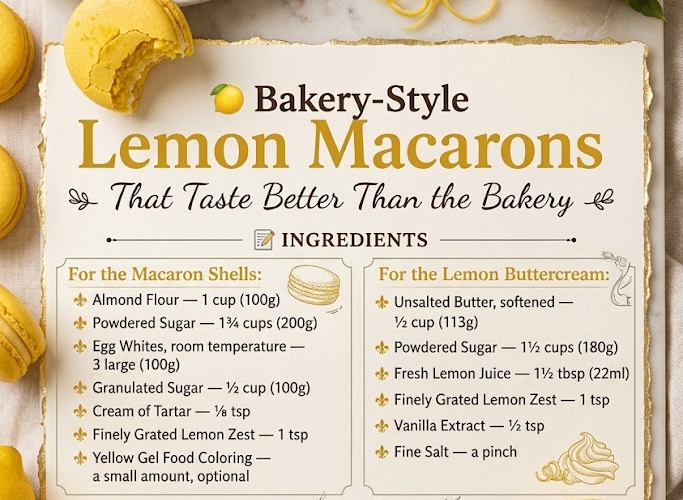
🍋 Bakery-Style Lemon Macarons
Delicate, crisp-edged, chewy-centered, and filled with silky lemon buttercream, these Bakery-Style Lemon Macarons have that elegant patisserie finish at home. Bright lemon zest cuts through the sweetness, giving the macarons a fresh citrus flavor.
⏱ Recipe Information
Prep Time: 30 minutes
Resting Time: 30–60 minutes
Bake Time: 12–15 minutes per tray
Total Time: About 2 hours
Yield: 24–28 filled macarons
Difficulty: Intermediate
🛒 Ingredients
🍋 For the Macaron Shells
- 1 cup (100 g) almond flour
- 1¾ cups (200 g) powdered sugar
- 3 large egg whites (100 g), room temperature
- ½ cup (100 g) granulated sugar
- ⅛ teaspoon cream of tartar
- 1 teaspoon finely grated lemon zest
- Yellow gel food coloring, a small amount, optional
🍋 For the Lemon Buttercream
- ½ cup (113 g) unsalted butter, softened
- 1½ cups (180 g) powdered sugar
- 1–2 tablespoons fresh lemon juice
- 1 teaspoon finely grated lemon zest
- ½ teaspoon vanilla extract
- Pinch of salt
- 1–2 tablespoons heavy cream or milk, as needed
Instructions
🍋 1. Prepare the Baking Equipment
Preheat the oven to 300°F (150°C).
Line two baking sheets with parchment paper or silicone macaron mats.
For the most consistent results, use an oven thermometer to check that your oven is actually reaching the correct temperature.
Prepare a piping bag fitted with a round ½-inch tip.
🌰 2. Sift the Dry Ingredients
Place the almond flour and powdered sugar in a bowl.
Sift them together twice.
Discard any large almond pieces that won’t pass through the sieve.
This step is important for smooth, bakery-style shells.
🥚 3. Whip the Egg Whites
Place the room-temperature egg whites and cream of tartar in a completely clean, dry mixing bowl.
Beat on medium speed until foamy.
Gradually add the granulated sugar while continuing to beat.
Increase to medium-high speed and whip until you have stiff, glossy peaks.
When you lift the whisk, the meringue should stand upright without drooping.
🍋 4. Add the Lemon Flavor
Add the finely grated lemon zest.
If using yellow gel coloring, add a very small amount.
Gently fold it into the meringue.
Use gel coloring rather than liquid food coloring because excess liquid can affect the macaron batter.
🌰 5. Make the Macaron Batter
Add approximately ⅓ of the sifted almond flour and powdered sugar to the meringue.
Fold gently.
Continue adding the dry ingredients in portions until incorporated.
Now begin the macaronage process.
Use your spatula to gently fold and press the batter against the sides of the bowl.
Continue until the batter becomes smooth and flows slowly from the spatula.
When lifted, the batter should fall in a continuous ribbon and disappear back into the mixture within roughly 10–15 seconds.
This consistency is critical.
Too thick = peaked, cracked shells.
Too thin = flat, spreading shells.
🎀 6. Pipe the Macarons
Transfer the batter to the prepared piping bag.
Pipe rounds approximately 1½ inches (3.5–4 cm) wide onto the baking sheets.
Hold the piping bag vertically and stop squeezing before lifting it away.
Gently tap the baking sheet against the counter several times to release trapped air bubbles.
Use a toothpick to pop any visible bubbles.
⏲️ 7. Let the Shells Rest
Allow the piped shells to sit at room temperature for approximately 30–60 minutes, depending on your humidity.
They’re ready when you can gently touch the surface without batter sticking to your finger.
This dry skin helps create the characteristic smooth tops and feet.
🔥 8. Bake
Bake one tray at a time for approximately 12–15 minutes.
The exact time depends on the size of your shells and your oven.
The shells should:
- Look smooth and set.
- Have developed small ruffled feet around the bottom.
- Not wobble significantly when gently touched.
Avoid opening the oven repeatedly during baking.
❄️ 9. Cool Completely
Remove the tray from the oven.
Allow the shells to cool completely on the baking sheet before attempting to remove them.
Once cool, they should peel away from the parchment relatively easily.
If they stick badly, they may need another minute or two of baking.
🍋 Make the Lemon Buttercream
10. Beat the Butter
Place the softened butter in a clean mixing bowl.
Beat for 3–4 minutes, until pale, fluffy, and creamy.
11. Add the Powdered Sugar
Gradually add the powdered sugar while mixing on low speed.
Once incorporated, increase the speed and beat until smooth.
12. Add Lemon
Add:
- Lemon juice
- Lemon zest
- Vanilla
- Salt
Beat for another 2–3 minutes.
If the buttercream is too thick, add heavy cream or milk 1 teaspoon at a time.
If it’s too loose, add a little more powdered sugar.
The finished buttercream should be smooth and firm enough to pipe.
🍋 13. Fill the Macarons
Transfer the buttercream to a piping bag.
Pipe a small mound of buttercream onto the flat side of half the macaron shells.
Place another shell on top.
Gently twist the top shell into place until the filling reaches the edges.
Don’t press too hard.
❄️ 14. Mature the Macarons
Place the filled macarons in an airtight container.
Refrigerate for 24 hours before serving.
This resting period allows moisture from the filling to move into the shells, creating that ideal combination of:
slightly crisp exterior + chewy center + creamy filling.
Bring them to room temperature for approximately 20–30 minutes before serving.
⭐ Chef’s Tips
Weigh Everything
Macarons are extremely sensitive to ingredient ratios. A kitchen scale gives much more reliable results than volume measurements.
Use Room-Temperature Egg Whites
They generally whip more easily and produce a stable meringue.
Keep Everything Grease-Free
Even a small amount of grease can prevent egg whites from whipping properly.
Don’t Overmix or Undermix
The macaronage stage determines the final shell texture.
Use Gel Coloring
Liquid coloring can thin the batter.
Bake One Tray at a Time
This gives you more consistent heat circulation and helps prevent uneven shells.
🍋 Troubleshooting
Cracked Tops
Possible causes include:
- Batter wasn’t rested long enough.
- Air bubbles weren’t removed.
- Oven temperature was too high.
- Meringue or batter was unstable.
No Feet
The batter may have been overmixed, the meringue underwhipped, or the shells may not have formed a proper skin.
Hollow Shells
Often caused by over-whipped meringue, incorrect macaronage, or excessive oven heat.
Sticky Bottoms
The shells may be slightly underbaked. Give them another 1–2 minutes next time.
Uneven Shapes
Pipe directly from above and keep the piping tip close to the surface of the tray.
🍋 Optional Lemon Curd Center
For an even stronger citrus flavor, pipe a ring of lemon buttercream around each shell and place a tiny amount of thick lemon curd in the center.
Then sandwich with the second shell.
This creates a beautiful lemon buttercream + lemon curd filling.
🧊 Storage
Store filled macarons in an airtight container.
Refrigerator: Up to 5–7 days.
Let them come to room temperature before serving for the best texture and flavor.
❄️ Freezing
Filled macarons can be frozen in an airtight container for up to 1 month.
Thaw them overnight in the refrigerator, then bring them to room temperature before serving.
Unfilled shells can also be frozen separately and filled later.
🍋✨ Recipe Summary
These Bakery-Style Lemon Macarons are elegant little treats with smooth lemon-kissed shells, delicate crisp edges, chewy centers, and rich, tangy lemon buttercream.
The secret to professional-looking macarons is precision: weigh your ingredients, whip the meringue properly, master the macaronage, and give the shells plenty of time to rest.
Bright, buttery, citrusy, and absolutely beautiful on a dessert table. 🍋💛