🧀🥛 Homemade Mozzarella Cheese
Fresh, milky, soft, and wonderfully stretchy, this Homemade Mozzarella Cheese transforms just a few simple ingredients into a delicious cheese you can make right in your own kitchen.
With full-fat milk, vinegar or lemon juice, water, and a little salt, you can make fresh mozzarella that’s perfect for pizza, pasta, sandwiches, salads, appetizers, and more.
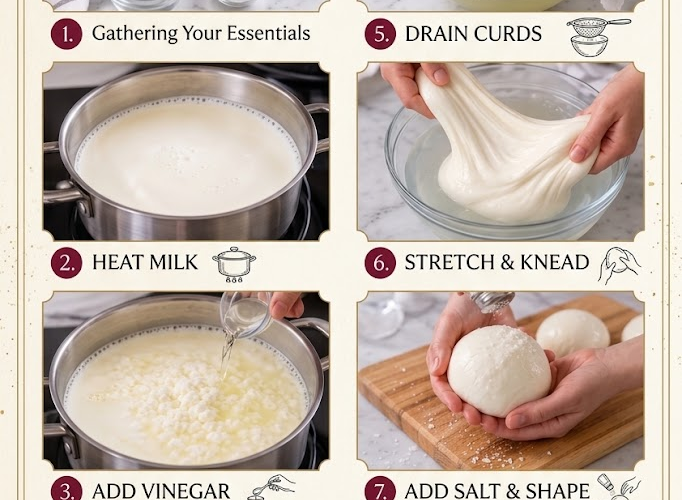
The key is gently heating the milk, separating the curds from the whey, and then working the curds with hot water until they become smooth and stretchy.
⏱️ Recipe Information
Prep Time: 10 minutes
Cook Time: 20–25 minutes
Stretching Time: 5–10 minutes
Total Time: About 45 minutes
Yield: Approximately 250–350 g fresh mozzarella
Difficulty: Intermediate
Method: Stovetop
🛒 Ingredients
- 2 liters (about 8½ cups) full-fat milk
- 2 tablespoons white vinegar OR fresh lemon juice
- 2 tablespoons water
- ½ teaspoon salt
You Will Also Need
- Large heavy-bottomed saucepan
- Fine-mesh sieve or colander
- Cheesecloth or clean kitchen cloth
- Large mixing bowl
- Slotted spoon
- Food-safe gloves, optional
- Kitchen thermometer, highly recommended
Important: Use regular pasteurized full-fat milk rather than ultra-high-temperature (UHT) milk when possible. UHT milk may not form suitable curds for this style of fresh mozzarella.
👩🍳 Instructions
🥛 Prepare the Milk
1. Combine the Acid and Water
In a small bowl, mix the 2 tablespoons vinegar or lemon juice with 2 tablespoons water.
Set aside.
2. Heat the Milk
Pour the milk into a large heavy-bottomed saucepan.
Place over medium-low heat and slowly warm the milk to approximately 85–90°C (185–194°F).
Stir gently from time to time to prevent the milk from scorching on the bottom.
Do not allow the milk to boil vigorously.
🧀 Form the Curds
3. Add the Acid
Once the milk is hot, remove the saucepan from the heat.
Slowly add the vinegar-water or lemon-water mixture while stirring gently.
Continue stirring for approximately 30–60 seconds.
You should begin to see the milk separate into white curds and yellowish whey.
4. Let the Milk Rest
Stop stirring and allow the mixture to rest for approximately 5–10 minutes.
The curds should become more defined and separate clearly from the whey.
If the liquid remains very milky rather than yellowish and the curds are not forming, add a small additional amount of vinegar or lemon juice, a little at a time.
Avoid adding too much acid, as it can produce a sour or crumbly cheese.
🧺 Separate the Curds
5. Transfer the Curds
Place a fine-mesh sieve or colander over a large bowl.
Line it with cheesecloth or a clean kitchen cloth.
Using a slotted spoon, gently transfer the curds into the lined sieve.
Allow the whey to drain.
6. Press Out Excess Whey
Gather the cheesecloth around the curds and gently squeeze to remove excess whey.
Don’t squeeze aggressively—the goal is to remove enough liquid to create a workable curd while keeping the cheese tender.
Reserve some of the hot whey if desired for storage.
🔥 Heat the Curds for Stretching
7. Prepare Hot Water
Heat a bowl or saucepan of clean water to approximately 75–80°C (167–176°F).
The water should be very hot but not violently boiling.
Add the salt to the hot water.
8. Warm the Curds
Place the drained curds in a heatproof bowl.
Pour some of the hot water over the curds.
Let them sit for approximately 1–2 minutes to soften.
If using gloves, put them on before handling the hot curds.
🧀 Stretch the Mozzarella
9. Begin Working the Curds
Carefully lift the softened curds from the hot water.
Gently press and fold them together.
As the curds warm, they should begin to become smooth and elastic.
10. Stretch and Fold
Gently stretch the cheese, fold it back onto itself, and repeat.
Work the mozzarella until it becomes:
- Smooth
- Glossy
- Elastic
- Soft
- Stretchy
Avoid excessive stretching.
Overworking the cheese can make it rubbery or tough.
If the curds become too firm to stretch, return them briefly to the hot water.
11. Shape the Mozzarella
Once the cheese becomes smooth and stretchy, shape it into a ball or several smaller balls.
Gently tuck the edges underneath to create a smooth surface.
❄️ Cool the Cheese
12. Place in Cold Water
Transfer the shaped mozzarella to a bowl of cold water.
This quickly cools the cheese and helps it hold its shape.
Let it sit for approximately 5 minutes.
13. Drain
Remove the mozzarella from the water and allow excess moisture to drain.
Your fresh homemade mozzarella is now ready to use.
⭐ Chef’s Tips
Choose the right milk
Full-fat regular pasteurized milk generally works best. Avoid UHT or ultra-pasteurized milk when possible because the high-heat processing can interfere with proper curd formation.
Don’t boil the milk
Overheating can negatively affect the curds and make the final cheese less tender.
Watch the curds
Once you add the acid, the milk should visibly separate into white curds and translucent yellowish whey.
Don’t over-acidify
If the milk doesn’t separate immediately, add acid gradually rather than pouring in a large amount at once.
Work with hot curds
Mozzarella becomes stretchy when the curds are sufficiently warm. If they stop stretching, warm them again.
Don’t overwork the cheese
A few gentle stretches and folds are usually enough. Excessive kneading can produce a dense, rubbery texture.
Use gloves
The stretching stage involves very hot water. Food-safe heat-resistant gloves can make the process much more comfortable.
🧀 How to Use Homemade Mozzarella
Fresh mozzarella is delicious in:
🍕 Pizza
Tear into pieces and scatter over pizza before baking.
🍅 Caprese Salad
Layer with fresh tomatoes and basil, then drizzle with olive oil.
🍝 Pasta
Tear into pieces and add to hot pasta dishes just before serving.
🥪 Sandwiches
Add slices to grilled sandwiches, paninis, and wraps.
🧄 Garlic Bread
Top toasted bread with mozzarella and bake until melted and bubbly.
🥗 Salads
Add torn mozzarella to green salads, tomato salads, or Mediterranean-style bowls.
🧊 Storage
Fresh mozzarella is best eaten within 1–2 days for the freshest flavor and texture.
Store it refrigerated in a clean airtight container.
You can keep the cheese submerged in lightly salted whey or a mild saltwater brine to help prevent it from drying out.
❄️ Can You Freeze Fresh Mozzarella?
Fresh mozzarella can technically be frozen, but freezing changes its delicate texture.
For the best results, enjoy it fresh.
If freezing is necessary, use frozen mozzarella primarily for cooked dishes such as pizza, casseroles, and baked pasta, where the texture change is less noticeable.
🧀🥛 Final Result
This Homemade Mozzarella Cheese is fresh, soft, milky, and wonderfully satisfying to make.
With just a few basic ingredients and a little patience, you can turn ordinary milk into smooth, stretchy homemade cheese that’s perfect for everything from pizza and pasta to fresh Caprese salad.
Fresh milk + a simple curd + gentle stretching = delicious homemade mozzarella! 🧀🥛✨