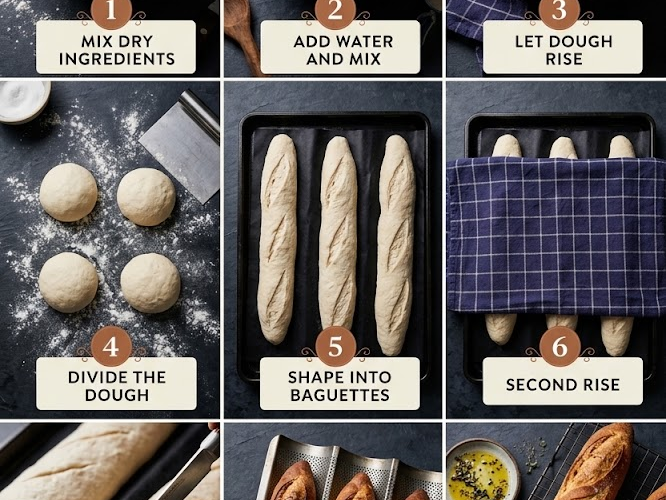
🥖 Homemade French Baguette
Nothing beats the aroma of freshly baked French baguettes coming from your own kitchen. This homemade version has a beautifully crisp, golden crust and a light, chewy interior with plenty of those classic rustic air pockets.
With just four basic ingredients—flour, water, yeast, and salt—you can make bakery-style baguettes at home. The key is giving the dough enough time to rise and handling it gently so you preserve the air developed during fermentation.
Recipe Information
- Prep Time: 25 minutes
- First Rise: 1½–2 hours
- Second Rise: 30–45 minutes
- Bake Time: 20–25 minutes
- Total Time: About 3 hours
- Yield: 2 medium baguettes
- Difficulty: Intermediate
- Method: Oven-baked
Ingredients
- 3 cups (375 g) all-purpose flour or bread flour
- 1½ cups (360 ml) warm water
- 2¼ teaspoons (7 g) instant yeast
- 1½ teaspoons (8 g) salt
For the Oven
- Boiling water, for creating steam
- Cornmeal or flour, for dusting the baking surface, optional
Instructions
1. Combine the Ingredients
Add the flour, instant yeast, and salt to a large mixing bowl.
Stir to combine.
Gradually pour in the warm water while mixing with a wooden spoon, spatula, or your hands.
Mix until a rough, shaggy dough forms and there are no large patches of dry flour.
The dough will be somewhat sticky, which is normal.
2. Knead the Dough
Transfer the dough to a lightly floured work surface.
Knead for about 8–10 minutes, until the dough becomes smoother and more elastic.
You can also knead it in a stand mixer fitted with a dough hook on low-medium speed for approximately 6–8 minutes.
Avoid adding too much extra flour. A slightly tacky dough produces a lighter baguette.
3. First Rise
Place the dough in a lightly oiled bowl.
Cover with plastic wrap or a clean kitchen towel.
Leave it in a warm, draft-free place for 1½–2 hours, or until the dough has approximately doubled in size.
For even better flavor, you can let the dough rise slowly in the refrigerator for 8–24 hours.
4. Divide the Dough
Gently turn the risen dough onto a lightly floured work surface.
Try not to press all the air out of it.
Divide the dough into 2 equal portions.
5. Shape the Baguettes
Working with one piece at a time, gently flatten it into a rough rectangle.
Fold the long sides toward the center and press gently to seal.
Roll the dough into a cylinder, starting from one long edge and rolling it tightly but gently.
Pinch the seam closed.
Using your palms, gently roll the dough outward from the center until it reaches approximately 14–16 inches (35–40 cm) long.
Repeat with the second piece.
6. Second Rise
Place the shaped baguettes seam-side down on a parchment-lined baking sheet or baguette tray.
If you don’t have a baguette pan, create folds in a clean kitchen towel and place the baguettes between the folds to help support their shape.
Cover loosely and let them rise for 30–45 minutes, until slightly puffy.
Don’t allow them to overproof—the dough should still spring back slightly when gently pressed.
7. Preheat the Oven
About 30 minutes before baking, preheat your oven to 475°F (245°C).
Place a heavy, oven-safe metal pan on the bottom rack of the oven while it preheats.
This pan will be used to create steam.
8. Score the Baguettes
Just before baking, use a very sharp knife, bread lame, or razor blade to make 3–4 diagonal cuts along the top of each baguette.
Hold the blade at a slight angle and make quick, confident cuts.
The cuts should overlap slightly rather than being placed straight across the loaf.
9. Create Steam
Place the baguettes in the oven.
Immediately pour about 1 cup (240 ml) boiling water into the hot empty pan on the bottom rack.
Close the oven door quickly to trap the steam.
Be extremely careful when adding the water, as hot steam can cause burns.
The steam helps create the baguette’s signature thin, crisp crust.
10. Bake
Bake at 475°F (245°C) for 10 minutes with steam.
Carefully remove the steam pan, or simply open the oven door briefly to release excess steam.
Reduce the temperature to 425°F (220°C) and continue baking for another 10–15 minutes, until the baguettes are deeply golden brown and sound hollow when tapped.
For an extra-crisp crust, leave them in the turned-off oven with the door slightly open for another 5 minutes.
11. Cool
Transfer the baguettes to a wire rack.
Allow them to cool for at least 20–30 minutes before slicing.
Although they smell irresistible, cutting immediately can compress the delicate interior and make it slightly gummy.
12. Slice and Serve
Use a serrated bread knife to slice the baguettes.
Serve warm with butter, olive oil, soup, cheese, sandwiches, or your favorite spreads.
Chef’s Tips
- Don’t add too much flour: The dough should be slightly sticky. Excess flour creates a dense loaf.
- Handle gently after the first rise: Preserving the air bubbles gives you a more open crumb.
- Use a kitchen scale: Flour measurements by volume can vary significantly.
- Steam is essential: It keeps the surface flexible during the first part of baking, helping the baguette expand and develop a crisp crust.
- Score just before baking: Scoring too early can allow the cuts to close during the final rise.
- Bake until deeply golden: A pale baguette usually won’t have the crisp crust or developed flavor you’re looking for.
- Don’t slice too soon: Letting the baguette cool allows the interior to finish setting.
Optional Overnight Fermentation
For deeper flavor and a more artisan-style baguette, reduce the yeast slightly to about 1 teaspoon and let the covered dough rise in the refrigerator for 8–24 hours.
Bring the dough out of the refrigerator, allow it to sit for about 20–30 minutes, then divide, shape, proof, and bake as directed.
The longer fermentation produces a more complex, flavorful loaf.
Storage
Fresh baguettes are best eaten the same day.
Store leftovers at room temperature in a paper bag or loosely wrapped kitchen towel for up to 2 days.
Avoid storing baguettes in a sealed plastic bag, as the crust will quickly soften.
To Re-Crisp
Place the baguette in a 375°F (190°C) oven for about 5–8 minutes.
You can lightly mist the crust with water before reheating to help restore its crispness.
Freezing
Baguettes freeze very well.
Once completely cool, wrap them tightly in foil or freezer-safe plastic wrap and freeze for up to 3 months.
Thaw at room temperature, then reheat at 375°F (190°C) for 8–10 minutes to refresh the crust.
Serving Ideas
Fresh baguette is delicious with:
- Salted butter
- Extra-virgin olive oil and herbs
- Garlic butter
- French cheese
- Soup or stew
- Bruschetta toppings
- Sandwich fillings
- Eggs and breakfast spreads
- Jam or honey
Final Result
A beautiful homemade baguette with a deeply golden, crackly crust and a light, chewy, airy center. The combination of proper fermentation, gentle shaping, scoring, and plenty of oven steam is what gives this simple four-ingredient bread its authentic bakery-style character.