🍓 French Macarons
Delicate, elegant, and irresistibly chewy, these classic French Macarons feature smooth almond shells with crisp edges, soft centers, and a delicious filling of your choice. Made with almond flour, powdered sugar, and perfectly whipped meringue, these beautiful little cookies are ideal for holidays, parties, afternoon tea, gifting, or whenever you want an impressive homemade dessert.
⏱️ Recipe Information
Prep Time: 30 minutes
Resting Time: 30–60 minutes
Bake Time: 12–16 minutes per tray
Total Time: About 1½–2 hours
Yield: 20–24 filled macarons
Difficulty: Intermediate
Method: Oven-Baked
Pan: Baking sheets lined with parchment paper or silicone macaron mats
🛒 Ingredients
For the Macaron Shells
- 1½ cups (150g) almond flour, finely ground
- 1¾ cups (175g) powdered sugar
- 3 large egg whites, room temperature
- ¼ cup (50g) granulated sugar
- ¼ teaspoon cream of tartar
- 1 teaspoon vanilla extract
- Gel food coloring, optional
For the Filling
Choose one:
- Buttercream
- Chocolate ganache
- Fruit jam
- Chocolate spread
- Lemon curd
- Salted caramel
You will need approximately 1–1½ cups of filling, depending on how generously you fill the macarons.
👩🍳 Instructions
1. Prepare the Baking Sheets
Line two baking sheets with parchment paper or silicone macaron mats.
If using parchment, you can place a macaron template underneath to help create evenly sized shells.
Set the baking sheets aside.
2. Sift the Dry Ingredients
Place the almond flour and powdered sugar in a large bowl.
Sift them together 1–2 times to remove lumps and create an exceptionally fine mixture.
If there are large pieces of almond flour left in the sieve, discard them rather than forcing them through.
Set the sifted mixture aside.
3. Whip the Egg Whites
Place the room-temperature egg whites in a completely clean, dry mixing bowl.
Using an electric mixer, beat on medium speed until the egg whites become foamy.
Add the cream of tartar.
Continue beating until soft peaks begin to form.
4. Gradually Add the Sugar
With the mixer running, slowly add the granulated sugar.
Increase to medium-high speed and continue beating until the meringue becomes thick, glossy, and forms stiff peaks.
When you lift the whisk, the peak should stand upright without drooping.
Add the vanilla extract.
If using gel food coloring, add a small amount at this stage.
Tip: Avoid liquid food coloring because it can add too much moisture to the meringue.
5. Fold in the Almond Mixture
Add about one-third of the sifted almond flour mixture to the meringue.
Using a rubber spatula, gently fold it in.
Add the remaining dry ingredients in two additions.
Continue folding until the mixture becomes smooth and flows slowly from the spatula.
6. Perfect the Macaronage
This is one of the most important steps.
Continue folding and gently pressing the batter against the side of the bowl to remove some of the air.
The finished batter should flow like thick lava.
When you lift the spatula, the batter should fall in a continuous ribbon and slowly disappear back into the mixture.
You should be able to draw a figure eight with the batter without it breaking.
Do not overmix. Overmixed batter can spread too much and produce thin, flat macarons.
Do not undermix. Undermixed batter can leave peaks, cracks, and uneven shells.
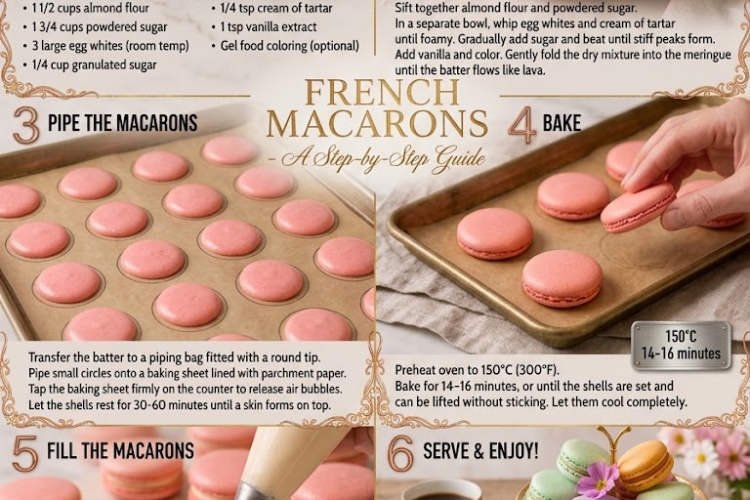
7. Pipe the Macarons
Transfer the batter to a piping bag fitted with a round piping tip.
Hold the bag straight above the baking sheet.
Pipe small circles approximately 1½ inches (4 cm) wide.
Stop squeezing before lifting the piping bag, then gently twist the tip away.
Leave about 1 inch of space between each macaron.
8. Remove Air Bubbles
Firmly tap the baking sheet against the counter several times.
This helps release trapped air bubbles.
Use a toothpick to pop any visible bubbles or smooth obvious peaks.
Allow the shells to sit uncovered at room temperature for approximately 30–60 minutes, depending on humidity.
The surface should become dry to the touch.
When you lightly touch a shell with your fingertip, the batter should not stick.
9. Preheat the Oven
Preheat your oven to 300°F (150°C).
For the most consistent results, use an oven thermometer if possible because oven temperatures can vary significantly.
Bake one tray at a time for the most even results.
10. Bake the Macaron Shells
Place the tray in the center of the oven.
Bake for approximately 12–16 minutes.
The shells are ready when:
- The tops look smooth and set.
- The shells have developed their characteristic ruffled “feet.”
- They do not wobble excessively when gently touched.
- The bottoms are set but not deeply browned.
If the macarons begin browning too quickly, reduce the oven temperature slightly.
11. Cool Completely
Remove the tray from the oven and allow the shells to cool completely on the baking sheet.
Do not try to remove them while they are still warm.
Once completely cooled, gently peel the shells from the parchment or silicone mat.
Pair shells of similar size.
🍫 12. Prepare the Filling
Prepare your chosen filling and transfer it to a piping bag.
Pipe a small mound of filling onto the flat side of one macaron shell.
Place a matching shell on top.
Gently press until the filling reaches the edges without spilling out.
Repeat with the remaining shells.
❄️ 13. Mature the Macarons
For the best texture, place the filled macarons in an airtight container and refrigerate them for at least 24 hours.
This resting period allows the filling to soften the inside of the shells while the exterior remains pleasantly delicate.
Before serving, bring the macarons to room temperature for approximately 20–30 minutes.
This is when their texture and flavor are at their best.
⭐ Chef’s Tips for Perfect French Macarons
Weigh Your Ingredients
Macarons are much more precise than ordinary cookies. A kitchen scale will give you considerably more reliable results than measuring cups.
Use Room-Temperature Egg Whites
Room-temperature whites whip more easily and produce a stable meringue.
Keep the Bowl Completely Clean
Even a small amount of grease or egg yolk can prevent the whites from whipping properly.
Don’t Skip the Sifting
Fine almond flour and powdered sugar help create smooth, elegant macaron shells.
Learn the “Lava” Consistency
The batter should flow slowly and smoothly. This is the key to getting smooth tops without excessive spreading.
Let the Shells Form a Skin
If the surface is still sticky when you touch it, allow the shells to rest longer before baking.
Avoid Opening the Oven Too Early
Opening the oven during the first part of baking can cause the shells to collapse or crack.
Macarons Improve After Resting
Freshly filled macarons can taste good, but resting them overnight usually produces a much better texture.
🍓 Filling Ideas
Classic Vanilla Buttercream
Pipe vanilla buttercream between the shells for a simple, elegant macaron.
Chocolate Ganache
Use dark, milk, or white chocolate ganache for a rich filling.
Strawberry Macarons
Fill vanilla or pink macaron shells with strawberry buttercream or strawberry jam.
Lemon Macarons
Fill yellow shells with lemon curd or lemon buttercream.
Raspberry Macarons
Pair pink shells with raspberry jam or raspberry buttercream.
Salted Caramel
Fill vanilla or caramel-colored shells with salted caramel buttercream.
Pistachio
Add a little pistachio extract or finely ground pistachios to the filling and pair with a white chocolate ganache.
🎨 Easy Flavor Variations
Chocolate Macarons
Replace about 2 tablespoons of almond flour with unsweetened cocoa powder.
Fill with chocolate ganache.
Coffee Macarons
Add a small amount of instant espresso powder to the filling and pair with coffee buttercream.
Coconut Macarons
Add coconut flavoring to the filling and finish with toasted coconut.
Orange Chocolate Macarons
Add finely grated orange zest to a chocolate ganache filling for a beautiful chocolate-orange combination.
Birthday Cake Macarons
Add colorful sprinkles to the filling and use pastel-colored shells.
🧊 Storage
Store filled macarons in an airtight container in the refrigerator for up to 5 days.
Allow them to sit at room temperature for 20–30 minutes before serving.
❄️ Freezing
Filled macarons can be frozen for up to 1 month.
Place them in a single layer in an airtight container, separating layers with parchment paper.
Thaw overnight in the refrigerator, then bring to room temperature before serving.
Unfilled shells can also be frozen for approximately 1–2 months.
🚨 Common Macaron Problems
Cracked Tops
Usually caused by trapped air, insufficient resting, excessive oven heat, or undermixed batter.
No Feet
This can happen when the meringue is weak, the batter is overmixed, the shells haven’t rested properly, or the oven temperature is too low.
Hollow Shells
Often caused by an unstable meringue, incorrect macaronage, or baking at too high a temperature.
Lopsided Macarons
Pipe the batter straight down rather than at an angle, and make sure the baking tray is level.
Sticky Bottoms
The shells may be underbaked. Bake slightly longer next time and allow them to cool completely before removing them.
🍓 Final Result
These French Macarons are delicate on the outside, chewy in the center, and wonderfully versatile.
With their smooth almond shells, signature ruffled feet, and creamy filling, they’re an elegant homemade treat that looks every bit as beautiful as it tastes.
A little patience, careful mixing, and proper resting are the secrets to perfect macarons every time. 🍓✨