🌸 French Macarons
These classic French Macarons have delicate, smooth shells with a crisp exterior, soft chewy centers, and a signature ruffled “foot.” Filled with silky buttercream, they make an elegant treat for afternoon tea, celebrations, gifting, holidays, or special desserts.
Macarons can be a little particular, but with properly aged egg whites, careful macaronage, and accurate measurements, you can achieve beautiful bakery-style results at home.
Recipe Information
- Prep Time: 30 minutes
- Resting Time: 30–60 minutes
- Bake Time: 14–18 minutes per batch
- Cooling Time: 30 minutes
- Total Time: About 2 hours
- Yield: 24–30 filled macarons
- Difficulty: Intermediate
- Method: Oven-baked
Ingredients
For the Macaron Shells
- 1 cup (100 g) almond flour
- 1¾ cups (200 g) powdered sugar
- 3 large egg whites (about 90–100 g), preferably at room temperature
- ¼ cup (50 g) granulated sugar
- ¼ teaspoon cream of tartar
- Gel food coloring, as desired
For the Filling
- ½ cup (113 g) unsalted butter, softened
- 1½ cups (180 g) powdered sugar, sifted
- 1 teaspoon vanilla extract
- 1–2 tablespoons heavy cream or milk
- Pinch of salt
Optional Filling Flavorings
- 1 tablespoon cocoa powder
- Lemon zest
- Freeze-dried strawberry powder
- Raspberry jam
- Pistachio paste
- Melted chocolate
Instructions
1. Prepare the Baking Sheets
Line two baking sheets with parchment paper or silicone macaron mats.
If using parchment, you can place a macaron template underneath it to help create evenly sized shells.
Set aside.
2. Prepare the Almond Flour Mixture
Sift the almond flour and powdered sugar together into a large bowl.
Sift them twice if possible.
Discard any large almond pieces that remain in the sieve.
This step is important for smooth, delicate macaron shells.
3. Prepare the Egg Whites
Place the egg whites in a completely clean, dry mixing bowl.
Make sure there is absolutely no trace of egg yolk, oil, or grease, as these can prevent the whites from whipping properly.
Add the cream of tartar.
Using an electric mixer, beat on medium speed until the egg whites become foamy.
4. Add the Granulated Sugar
Gradually add the granulated sugar while continuing to beat.
Increase the mixer to medium-high speed and whip until the egg whites form firm, glossy peaks.
When you lift the whisk, the peak should stand upright with only a slight curve at the tip.
Do not overbeat until the whites become dry or clumpy.
5. Add the Food Coloring
Add a small amount of gel food coloring to the whipped egg whites.
Mix briefly until the color is evenly distributed.
Gel coloring is preferable because it adds strong color without introducing much extra liquid.
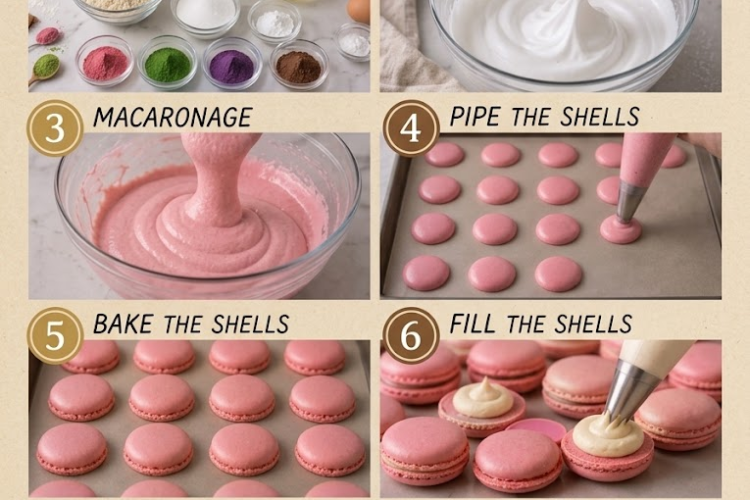
6. Begin the Macaronage
Add about one-third of the sifted almond flour and powdered sugar mixture to the whipped egg whites.
Using a silicone spatula, gently fold it in.
Add the remaining dry ingredients in two additions.
Once incorporated, begin gently pressing and folding the batter against the sides of the bowl.
This process is called macaronage.
7. Check the Batter Consistency
Continue folding until the batter becomes smooth, glossy, and flows slowly from the spatula.
When you lift the spatula, the batter should fall in a thick ribbon and disappear back into the mixture within approximately 10–15 seconds.
You should be able to draw a figure eight with the batter without it breaking.
Be careful not to overmix. An overly thin batter can cause the macarons to spread and lose their feet.
8. Pipe the Macaron Shells
Transfer the batter to a piping bag fitted with a plain round tip.
Hold the bag straight above the baking sheet.
Pipe circles approximately 1½ inches (4 cm) in diameter, leaving about 1 inch between each shell.
Stop squeezing before lifting the piping bag, then gently release to avoid creating points.
9. Release Air Bubbles
Firmly tap each baking sheet against the counter several times.
This helps remove trapped air bubbles and prevents hollow shells.
Use a toothpick to pop any visible bubbles on the surface.
10. Let the Shells Rest
Leave the piped macarons uncovered at room temperature for 30–60 minutes, depending on humidity.
They are ready to bake when you can gently touch the surface and it feels dry rather than sticky.
A thin skin should have formed over the shells.
11. Preheat the Oven
Preheat the oven to 300°F (150°C).
For the most consistent results, use an oven thermometer because home ovens can run hotter or cooler than their displayed temperature.
12. Bake
Bake one tray at a time for approximately 14–18 minutes.
The exact time depends on the size of your shells and your oven.
The macarons should rise and develop their characteristic ruffled feet.
The tops should remain smooth and should not move when gently touched.
If the shells begin browning, lower the temperature slightly or loosely tent them with foil near the end of baking.
13. Cool Completely
Remove the baking sheet from the oven and allow the shells to cool completely before attempting to remove them.
Once cooled, they should peel away from the parchment easily.
If they stick, they may need another minute or two of baking.
Make the Filling
14. Beat the Butter
Place the softened butter in a mixing bowl.
Beat for 2–3 minutes until smooth, pale, and fluffy.
15. Add the Powdered Sugar
Gradually add the sifted powdered sugar while mixing on low speed.
Once incorporated, add the vanilla and salt.
Increase the mixer speed and beat until light and creamy.
16. Adjust the Consistency
Add the heavy cream or milk, 1 teaspoon at a time, until the buttercream reaches a smooth piping consistency.
If making chocolate filling, add cocoa powder.
For fruit-flavored filling, add a small amount of fruit powder or jam.
17. Fill the Macarons
Transfer the buttercream to a piping bag fitted with a round or star tip.
Pipe a small mound of filling onto the flat side of half the macaron shells.
Place another shell on top and gently twist until the filling reaches the edges.
Avoid pressing too hard.
18. Mature the Macarons
For the best flavor and texture, place the filled macarons in an airtight container and refrigerate for 24 hours.
This allows the filling to soften the inside of the shells while the exterior remains delicately crisp.
Bring them to room temperature for about 15–20 minutes before serving.
Chef’s Tips
- Weigh the ingredients: Macarons are much more reliable when measured with a digital scale.
- Keep everything grease-free: Even a small amount of fat can prevent the egg whites from whipping properly.
- Sift thoroughly: This creates smooth, elegant shells.
- Don’t overmix: Macaronage is one of the most important steps.
- Don’t undermix: Thick batter can leave pointed tops and uneven shells.
- Tap out air bubbles: Trapped air can cause hollow macarons or cracked tops.
- Allow a skin to form: This helps create smooth tops and proper feet.
- Bake one tray at a time: This gives you greater control over heat and airflow.
- Let them mature: Macarons often taste even better the next day.
Common Macaron Problems
Cracked Tops
Usually caused by trapped air bubbles, insufficient resting, or excessive oven heat.
No Feet
The batter may have been overmixed, the shells may not have rested long enough, or the oven temperature may have been too low.
Hollow Shells
Often caused by under-mixing, trapped air, or incorrect oven temperature.
Lopsided Macarons
Usually caused by uneven piping, air bubbles, or an oven with uneven heat.
Sticky Bottoms
The shells may be slightly underbaked or need more cooling time.
Flavor Variations
Chocolate Macarons
Replace about 2 tablespoons of almond flour with 2 tablespoons unsweetened cocoa powder.
Fill with chocolate ganache or chocolate buttercream.
Raspberry Macarons
Add freeze-dried raspberry powder to the buttercream or pipe a small dot of raspberry jam in the center of the filling.
Lemon Macarons
Add finely grated lemon zest to the buttercream and a few drops of lemon juice.
Pistachio Macarons
Add 1–2 tablespoons pistachio paste to the buttercream.
Coffee Macarons
Add 1 teaspoon instant espresso powder to the filling.
Salted Caramel Macarons
Fill with caramel buttercream and add a tiny pinch of flaky sea salt.
Storage
Store filled macarons in an airtight container in the refrigerator for up to 5 days.
For the best texture, allow them to come to room temperature before serving.
Freezing
Macarons freeze beautifully.
Place filled or unfilled macarons in an airtight freezer-safe container with parchment paper between layers.
Freeze for up to 1 month.
Thaw in the refrigerator, then bring to room temperature before serving.
Final Result
Elegant French Macarons with smooth, delicate shells, crisp edges, soft chewy centers, and beautiful ruffled feet, paired with a creamy vanilla buttercream filling. After a day of maturation, they become wonderfully balanced—delicate on the outside, chewy inside, and irresistibly flavorful.