🍞 Filipino Bread (Pan de Sal)
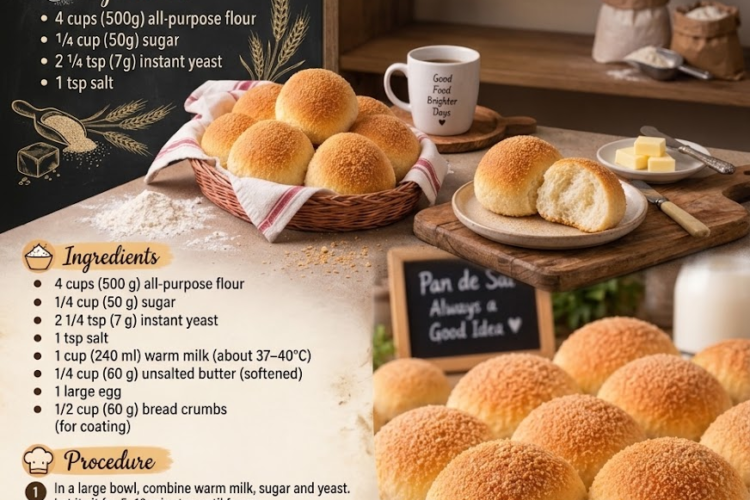
Soft, fluffy, lightly sweet Filipino bread with a tender buttery center and a delicate breadcrumb coating.
Pandesal, also spelled pan de sal, is one of the Philippines’ most beloved everyday breads. These small, golden-brown rolls are wonderfully soft inside, slightly crisp on the outside, and coated in fine breadcrumbs for their classic texture.
They’re delicious fresh from the oven with butter, cheese, jam, eggs, or your favorite Filipino breakfast spread.
⏱️ Recipe Information
Prep Time: 25 minutes
First Rise: 1–1½ hours
Second Rise: 30–45 minutes
Bake Time: 18–22 minutes
Total Time: About 2½ hours
Yield: 16–20 rolls
Difficulty: Easy
Method: Oven-Baked
🛒 Ingredients
🍞 For the Dough
- 4 cups (500g) all-purpose flour
- ¼ cup (50g) granulated sugar
- 2¼ teaspoons (7g) instant yeast
- 1 teaspoon salt
- 1 cup (240ml) warm milk, about 37–40°C (98–104°F)
- ¼ cup (60g) unsalted butter, softened
- 1 large egg
🌾 For Coating
- ½ cup (60g) fine breadcrumbs
Optional for Serving
- Butter
- Cheese
- Peanut butter
- Coconut jam
- Fruit jam
- Condensed milk
👩🍳 Procedure
1. Combine the Dry Ingredients
In a large mixing bowl, combine the flour, sugar, instant yeast, and salt.
Whisk briefly to distribute the yeast and salt evenly.
🥛 2. Add the Wet Ingredients
Make a well in the center of the flour mixture.
Pour in the warm milk.
Add the softened butter and egg.
Mix with a wooden spoon or sturdy spatula until a rough, sticky dough begins to form.
✋ 3. Knead the Dough
Transfer the dough to a lightly floured work surface.
Knead for approximately 8–10 minutes, until the dough becomes smooth, soft, and elastic.
You can also knead using a stand mixer fitted with a dough hook for approximately 6–8 minutes on medium-low speed.
The dough should feel soft and slightly tacky but should not be excessively sticky.
Avoid adding too much flour.
🌡️ 4. First Rise
Shape the dough into a smooth ball.
Place it in a lightly greased bowl.
Cover with plastic wrap or a clean kitchen towel.
Place in a warm, draft-free area and let rise for approximately 1–1½ hours, or until doubled in size.
The exact rising time depends on the temperature of your kitchen.
🍞 5. Shape the Dough
Once the dough has doubled, gently press it down to release excess air.
Transfer it to a lightly floured surface.
Roll the dough into a thick log approximately 2½–3 inches (6–8cm) in diameter.
Using a sharp knife or bench scraper, cut the log into 16–20 equal pieces.
For uniform rolls, weigh the dough and divide it evenly.
🌾 6. Coat With Breadcrumbs
Place the breadcrumbs in a shallow dish.
Lightly roll each piece of dough in the breadcrumbs, making sure the surface is evenly coated.
Pandesal traditionally has a generous breadcrumb coating, so don’t be afraid to cover the dough well.
🥖 7. Arrange the Rolls
Place the coated dough pieces on a parchment-lined baking sheet.
Leave a little space between them so they can expand as they rise.
For softer-sided pandesal, arrange them relatively close together.
For more defined individual rolls, leave more space between each piece.
🌡️ 8. Second Rise
Cover the rolls loosely with a clean kitchen towel.
Allow them to rise for approximately 30–45 minutes, or until noticeably puffy.
Don’t let them become excessively swollen; they should still have enough structure to hold their shape.
🔥 9. Bake
Preheat the oven to 350°F (175°C).
Place the risen pandesal in the oven.
Bake for approximately 18–22 minutes, or until the tops are lightly golden and the bottoms are cooked through.
Pandesal is generally softer and lighter in color than crusty European-style bread, so avoid waiting for a very dark brown crust.
🧈 10. Cool
Remove the rolls from the oven.
Transfer them to a wire rack.
Allow them to cool for approximately 10–15 minutes.
They’re especially delicious while still warm.
🍞 11. Serve
Split a warm pandesal and fill it with your favorite spread or filling.
Try it with:
- Salted butter
- Cheese
- Peanut butter
- Jam
- Coconut jam
- Scrambled eggs
- Ham and cheese
- Condensed milk
Serve alongside coffee, tea, hot chocolate, or a Filipino-style breakfast.
⭐ Chef’s Tips
Keep the milk warm, not hot: Around 37–40°C is ideal. Excessively hot milk can damage the yeast.
Don’t overload with flour: A softer dough produces softer pandesal.
Knead until elastic: Proper gluten development gives the rolls their characteristic fluffy texture.
Let the dough fully double: The first rise is important for developing both volume and flavor.
Use fine breadcrumbs: Fine breadcrumbs give pandesal its traditional delicate coating.
Coat before the second rise: This allows the breadcrumbs to adhere naturally as the dough expands.
Don’t overbake: Pandesal should remain soft and tender rather than developing a thick, hard crust.
For extra-soft rolls: Brush the tops lightly with melted butter immediately after baking.
🧀 Easy Variations
🧀 Cheese Pandesal
Flatten each dough piece slightly, place a small cube of cheddar or your favorite cheese in the center, then seal and roll before coating with breadcrumbs.
🥓 Ham & Cheese Pandesal
Add finely diced ham and cheese to the center for a savory breakfast roll.
🍫 Chocolate Pandesal
Fill each piece with chocolate or chocolate-hazelnut spread before shaping.
🥥 Ube Pandesal
Fill the dough with ube halaya before coating and baking.
🧄 Garlic Butter Pandesal
Brush freshly baked rolls with melted garlic butter and a little chopped parsley.
🍯 Sweet Pandesal
Serve warm with butter and honey, jam, or condensed milk.
🍽️ Serving Suggestions
Pandesal is traditionally enjoyed as part of breakfast or merienda.
Serve warm with:
- Coffee
- Hot chocolate
- Tea
- Scrambled eggs
- Fried eggs
- Filipino-style sausage
- Cheese
- Butter and jam
- Peanut butter
- Coconut jam
They’re also excellent as small sandwich rolls.
🧊 Storage
Allow pandesal to cool completely before storing.
Place in an airtight container or sealed bag and keep at room temperature for up to 3 days.
For the softest texture, keep them tightly sealed.
🔥 Reheating
Warm individual rolls in a 300°F (150°C) oven for approximately 5 minutes.
You can also microwave one roll for about 10–15 seconds.
For an especially delicious finish, split the roll and lightly toast it before adding butter or cheese.
❄️ Freezing
Pandesal freezes very well.
Allow the baked rolls to cool completely, then place them in a freezer-safe bag.
Freeze for up to 2 months.
Thaw at room temperature and warm briefly in the oven before serving.
For fresher results, you can also freeze shaped, unbaked dough after the first rise. Thaw in the refrigerator overnight, allow it to become puffy at room temperature, then bake as directed.
🍞🇵🇭✨ Final Result
Homemade Filipino Pan de Sal is wonderfully soft, fluffy, buttery, and lightly sweet, with the unmistakable fine-breadcrumb coating that makes pandesal so special.
Fresh from the oven, they’re warm and tender enough to tear apart with your hands, making them perfect with a pat of butter, melted cheese, jam, or a steaming cup of coffee.
Simple ingredients, comforting Filipino tradition, and irresistibly soft homemade bread. 🍞🇵🇭✨