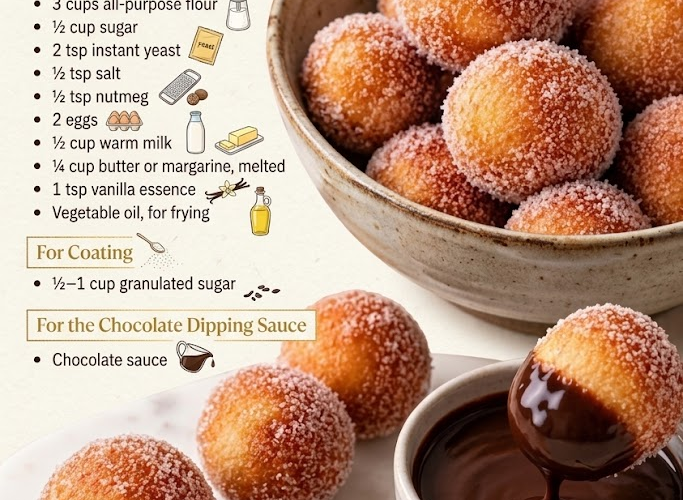
🍩 Doughnut Balls
Soft, fluffy, golden-brown doughnut balls with a lightly spiced, buttery interior and a sweet coating. These bite-sized treats are perfect for breakfast, afternoon tea, parties, or an easy homemade dessert.
Recipe Information
- Prep Time: 20 minutes
- Rising Time: 1–1½ hours
- Frying Time: 15 minutes
- Total Time: About 2 hours
- Yield: 30–36 doughnut balls
- Difficulty: Easy
- Method: Deep-fried
Ingredients
For the Dough
- 3 cups (375 g) all-purpose flour
- ½ cup (100 g) granulated sugar
- 2 tsp instant yeast
- ½ tsp salt
- ½ tsp ground nutmeg
- 2 large eggs, room temperature
- ½ cup (120 ml) warm milk
- ¼ cup (57 g) butter or margarine, melted and slightly cooled
- 1 tsp vanilla essence
- Vegetable oil, for deep-frying
For the Coating
- ½ cup (100 g) granulated sugar
- ½ tsp ground cinnamon, optional
- ¼ tsp ground nutmeg, optional
Instructions
1. Mix the dry ingredients
In a large mixing bowl, whisk together the flour, sugar, instant yeast, salt, and nutmeg.
Make sure the yeast is distributed evenly throughout the flour.
2. Add the wet ingredients
In a separate bowl, whisk together the eggs, warm milk, melted butter, and vanilla.
Pour the wet mixture into the dry ingredients.
Using a wooden spoon or sturdy spatula, mix until a soft, sticky dough forms.
3. Knead the dough
Transfer the dough to a lightly floured work surface.
Knead for approximately 8–10 minutes, until the dough becomes smooth, elastic, and slightly tacky.
Alternatively, use a stand mixer fitted with a dough hook and knead on low-medium speed for about 5–7 minutes.
The dough should feel soft and supple. Avoid adding too much flour, as this can make the doughnut balls dense.
4. Let the dough rise
Place the dough in a lightly greased bowl.
Cover with plastic wrap or a clean kitchen towel.
Set it in a warm, draft-free place and let it rise for approximately 1–1½ hours, or until doubled in size.
5. Prepare the coating
While the dough rises, combine the granulated sugar, cinnamon, and optional nutmeg in a shallow bowl.
Set aside for coating the freshly fried doughnut balls.
6. Shape the doughnut balls
Once the dough has doubled in size, gently punch it down to release excess air.
Pinch off small portions of dough and roll them between your palms into smooth balls approximately 1½ inches (4 cm) wide.
Try to keep them similar in size so they cook evenly.
Place the shaped balls on a lightly floured or parchment-lined tray.
Cover loosely and let them rest for 15–20 minutes.
7. Heat the oil
Pour vegetable oil into a deep, heavy-bottomed saucepan or Dutch oven to a depth of about 2–3 inches (5–7 cm).
Heat the oil to 350°F (175°C).
Use a kitchen thermometer for the most reliable results.
If the oil is too hot, the outside will brown before the centers cook. If it’s too cool, the doughnut balls will absorb excess oil.
8. Fry the doughnut balls
Carefully lower several doughnut balls into the hot oil, working in small batches.
Don’t overcrowd the pan.
Fry for approximately 3–4 minutes, turning frequently with a slotted spoon so they brown evenly on all sides.
They should become beautifully golden brown and puff up as they cook.
9. Drain
Remove the cooked doughnut balls with a slotted spoon.
Place them on a wire rack set over a baking sheet or on a paper towel-lined plate.
Allow excess oil to drain for about 30 seconds.
10. Coat while warm
While the doughnut balls are still warm, roll them generously in the prepared cinnamon sugar.
Make sure they’re coated on all sides.
For an extra-sweet finish, roll them twice.
11. Serve
Serve the doughnut balls warm or at room temperature.
They’re delicious on their own or alongside coffee, tea, hot chocolate, or a cold glass of milk.
Chef’s Tips
- Keep the dough soft. Too much flour produces heavy, dense doughnut balls.
- Make sure the milk is warm rather than hot. Very hot liquid can damage the yeast.
- Let the dough fully double during the first rise for the fluffiest texture.
- Keep the frying oil around 350°F (175°C) and allow it to return to temperature between batches.
- Fry in small batches to prevent the oil temperature from dropping.
- Turn the doughnut balls frequently while frying so they brown evenly.
- If you’re unsure whether they’re cooked, remove one and cut it open. The center should be fluffy and completely cooked, with no wet dough.
Easy Variations
Powdered Sugar Doughnut Balls
Skip the cinnamon sugar and toss the cooled doughnut balls in powdered sugar.
Glazed Doughnut Balls
Mix:
- 1 cup (120 g) powdered sugar
- 2 tbsp milk
- ½ tsp vanilla
Whisk until smooth, then dip the cooled doughnut balls into the glaze.
Chocolate Doughnut Balls
Dip the fried doughnut balls into melted chocolate and sprinkle with chopped nuts or colorful sprinkles.
Coconut Sugar
Replace half of the coating sugar with finely shredded coconut for a tropical variation.
Jam-Filled Doughnut Balls
After frying, use a piping bag fitted with a small round tip to inject each doughnut ball with strawberry, raspberry, or apricot jam.
Make-Ahead
The dough can be prepared and refrigerated after kneading for up to 24 hours.
Allow it to come closer to room temperature and complete its rise before shaping and frying.
For the best texture, fry the doughnut balls shortly before serving.
Storage
Store completely cooled doughnut balls in an airtight container at room temperature for up to 2 days.
They are best enjoyed on the day they’re fried.
Reheating
Warm them briefly in a 300°F (150°C) oven for 5–7 minutes or microwave individual pieces for about 10–15 seconds.
Avoid overheating, which can make them chewy.
The Result
The perfect Doughnut Balls should be golden and lightly crisp outside, wonderfully soft and fluffy inside, with a warm buttery-nutmeg flavor and a sweet cinnamon-sugar coating. They’re dangerously easy to pop one after another!