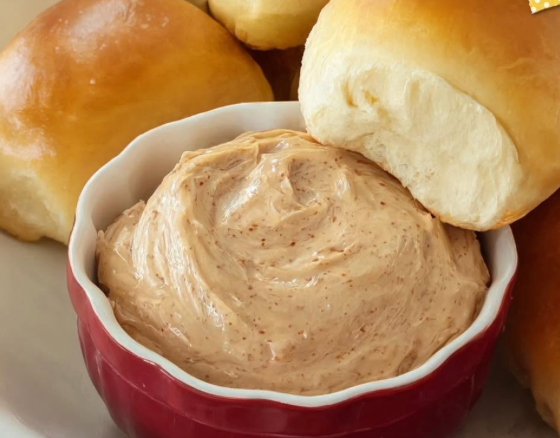
Anyone who has stepped inside a Texas Roadhouse knows that the legendary, bottomless baskets of warm, square yeast rolls—served with a crock of whipped cinnamon honey butter—are the real reason people walk through the door.
These rolls have a distinct personality: they are sweet, deeply buttery, and so tender and pillowy that you can pull them apart with practically zero resistance. Unlike crusty artisan sourdough or dense dinner rolls, these feature a featherlight, cotton-soft crumb and a glossy, golden-brown crown slicked with melted butter the moment they leave the oven.
Replicating that restaurant-quality texture at home is not a matter of luck or commercial additives; it comes down to yeast hydration, fat-enrichment mechanics, and the signature “fold-and-cut” shaping method that gives each roll its clean, pull-apart square seams.
The Science Behind the Featherlight Crumb
- The Role of Milk & Scalding: Using whole milk instead of water introduces lactose (milk sugar) and butterfat. Lactose caramelizes rapidly in the oven, creating that golden-brown crust at a gentle 350°F (175°C) without over-baking the interior. The milk fats coat gluten proteins, tenderizing the crumb into a soft, melt-in-your-mouth web.
- Honey as a Natural Humectant: Granulated sugar sweetens, but honey contains fructose and glucose, which are hygroscopic (they actively attract and hold onto water molecules). This keeps the baked rolls soft and fresh on the counter for days, preventing the crumb from drying out or going stale overnight.
- Fat Enrichment (Egg & Melted Butter): Whole eggs add structure via albumen while the yolk supplies lecithin, a natural emulsifier that binds water and butterfat into a supple dough. Melted butter tenderizes the gluten strands so the rolls rise tall and fluffy rather than chewy like pizza crust.
- The “Fold-and-Cut” Rectangle Technique: Texas Roadhouse rolls are famous for their puffy, squarish shape with a natural split along the side. Instead of rolling individual balls between your palms, the dough is rolled into a rectangle, folded in half onto itself, and sliced into rectangles with a bench scraper or pizza wheel. As the rolls proof and bake, that folded seam puffs outward, creating that signature pull-apart cleft.
Complete Ingredients Breakdown
For the Sweet Enriched Dough:
- 2 ¼ teaspoons (1 standard packet / 7 g) active dry or instant yeast
- 1 ¼ cups (300 ml) whole milk, warmed to $105\text{°F} – 110\text{°F}$ ($40\text{°C} – 43\text{°C}$)
- ¼ cup (85 g / 60 ml) pure clover or wildflower honey
- 4 tablespoons (½ stick / 55 g) unsalted butter, melted and cooled to lukewarm
- 1 large egg, room temperature
- 1 teaspoon (5 g) kosher salt
- 4 cups (500 g) all-purpose flour (spooned and leveled; keep an extra 2–3 tbsp handy for dusting)
- 2 to 3 tablespoons unsalted butter, melted (for brushing the hot baked rolls)
For the Whipped Cinnamon Honey Butter:
- ½ cup (1 stick / 115 g) unsalted butter, softened to room temperature (not melted!)
- ½ cup (60 g) powdered sugar, sifted (eliminates grit)
- ½ cup (170 g / 120 ml) pure honey
- 1 teaspoon ground cinnamon (use Saigon/cassia cinnamon for that bold bakery aroma)
- A small pinch of fine sea salt (cuts through the intense sweetness and sharpens the honey notes)
Step-by-Step Master Instructions
1. Proof the Yeast
- In the bowl of a stand mixer (or a large mixing bowl), combine the 1 ¼ cups warm whole milk and 2 ¼ teaspoons yeast.
- Stir in 1 teaspoon of the measured honey to feed the yeast.
- Let the mixture sit undisturbed for 5 to 10 minutes.
- Visual Cue: The surface should develop a thick, frothy, tan foam that smells yeasty and alive. If it remains flat after 10 minutes, the milk was either too hot (killing the yeast) or the yeast was expired; discard and start fresh with a new packet.
2. Build the Enriched Liquid Base
- To the foamy yeast mixture, add the remaining honey, the 4 tablespoons melted butter (ensure it’s not hot, or it will cook the egg), the room-temperature egg, and the 1 teaspoon kosher salt.
- Whisk gently by hand until the egg is broken up and the honey dissolves into the milk.
3. Incorporate Flour & Knead to Silkiness
- Attach the dough hook to your stand mixer (or use a sturdy wooden spoon).
- Add the 4 cups of all-purpose flour in two separate additions:
- Add the first 2 cups and mix on low speed until a wet, batter-like dough forms.
- Add the remaining 2 cups and mix until the flour hydrates and forms a shaggy dough pulling away from the bowl.
- Knead on medium-low speed for 6 to 8 minutes (or 8 to 10 minutes by hand on a lightly floured surface).
- The Windowpane / Texture Cue: The dough should transform into a soft, satin-smooth, supple ball that is slightly tacky to the touch but does not leave dough clinging to your fingers. If the dough is sticking heavily to the sides of the bowl after 5 minutes of kneading, sprinkle in 1 tablespoon of flour at a time until it cleans the bowl.
4. The First Rise (Bulk Fermentation)
- Lightly grease a large, clean bowl with a few drops of neutral oil or butter.
- Form the dough into a smooth ball, tucking the edges underneath, and place it in the bowl, turning it once to coat the surface.
- Cover the bowl tightly with plastic wrap or a clean damp kitchen towel.
- Place in a warm, draft-free spot for 60 to 75 minutes, or until the dough has doubled in volume. (A great trick: place the bowl inside an unheated oven with the interior oven light turned on; the bulb provides the ideal 80°F proofing warmth).
5. The Signature “Fold-and-Cut” Shaping Method
- Line two large rimmed baking sheets with parchment paper or brush lightly with butter.
- Gently punch down the risen dough to deflate the large gas pockets.
- Turn the dough out onto a lightly floured countertop.
- Using a rolling pin, roll the dough into a large rectangle about ½-inch thick (roughly 12×16 inches).
- The Secret Fold: Fold the top half of the rectangle down over the bottom half, creating a folded rectangle that is now about 1 inch thick.
- Using a sharp pizza wheel or metal bench scraper, cut the folded dough into 16 to 20 equal rectangles(cut in straight downward presses rather than sawing, so the edges stay open to expand).
- Transfer the rolls to the prepared baking sheets, spacing them about 1 to 1 ½ inches apart. (Leaving a small gap allows them to puff sideways into each other slightly during baking, keeping the sides ultra-soft and pull-apart tender).
6. The Second Rise (The Final Proof)
- Cover the baking sheets loosely with clean, dry cotton kitchen towels.
- Let the rolls rise for 30 to 45 minutes at room temperature until visibly puffed, pillowy, and tender when lightly poked with a flour-dusted fingertip.
7. Bake to Golden Perfection
- While the rolls finish their second rise, preheat your oven to 350°F (175°C) with the racks in the upper-middle and lower-middle positions.
- Bake the rolls for 12 to 15 minutes (rotate the pans front-to-back at the 8-minute mark for even coloring).
- Doneness Cue: The rolls should be puffed, fragrant, and have a rich, golden-brown crust on top and bottom.
- The second they come out of the oven, use a pastry brush to generously slather the tops with 2 to 3 tablespoons of melted butter. This gives them that mouthwatering, mirror-like Roadhouse shine and keeps the crust velvet-soft as it cools.
8. Whip the Legendary Cinnamon Honey Butter
- In a medium mixing bowl (or using a handheld electric mixer), add the ½ cup softened butter. Beat on medium-high speed for 2 minutes until pale, fluffy, and aerated.
- Add the ½ cup sifted powdered sugar, ½ cup honey, 1 teaspoon cinnamon, and a pinch of salt.
- Start on low speed so the powdered sugar doesn’t fly out of the bowl, then crank the speed up to high and beat for 2 to 3 minutes.
- The Target Texture: The butter will transform into an ultra-fluffy, light-brown, spreadable cloud that holds soft peaks like frosting. Scoop it into a serving crock or ramekin.
Baker’s Troubleshooting Matrix
| Issue | Root Cause | Prevention & Fix |
| Dough refused to rise | Milk was too hot ($>120\text{°F}$kills yeast) or cold; yeast was dead. | Verify milk temperature ($105\text{°F}–110\text{°F}$); always wait 5–10 min for foamy bubbles before continuing. |
| Rolls are heavy and dense | Too much flour was added during kneading, or the second rise was rushed. | Keep the dough soft and tacky; let the shaped rolls proof until pillowy and doubled in height before baking. |
| Rolls flattened out instead of puffing | Over-proofed on the second rise, weakening the gluten web. | Bake promptly once puffy; do not let them sit out longer than 45 minutes on the sheet pan. |
| Honey butter split or looks grainy | Butter was too cold or partially melted; granulated sugar was used instead of powdered. | Butter must be room-temp soft; always use sifted powdered sugar and beat on high speed until completely emulsified. |
Make-Ahead, Storage & Reheating
- Overnight Refrigerator Method: After cutting and arranging the rolls on the baking sheet, cover tightly with oiled plastic wrap and immediately refrigerate overnight (up to 16 hours). In the morning, set the pan on the counter for about 60 to 75 minutes to take off the chill and finish rising, then bake as directed.
- Freezing Baked Rolls: Let the baked rolls cool completely to room temperature (skip the melted butter brush if freezing). Seal in a heavy-duty freezer bag for up to 3 months. Thaw at room temperature for 1 hour.
- The Restaurant Reheating Move: To recreate that hot-from-the-kitchen experience, wrap the rolls loosely in aluminum foil and heat in a 300°F (150°C) oven for 7 to 8 minutes. Brush with fresh melted butter, pull one open, and let a generous dollop of cinnamon honey butter melt directly into the steaming center!