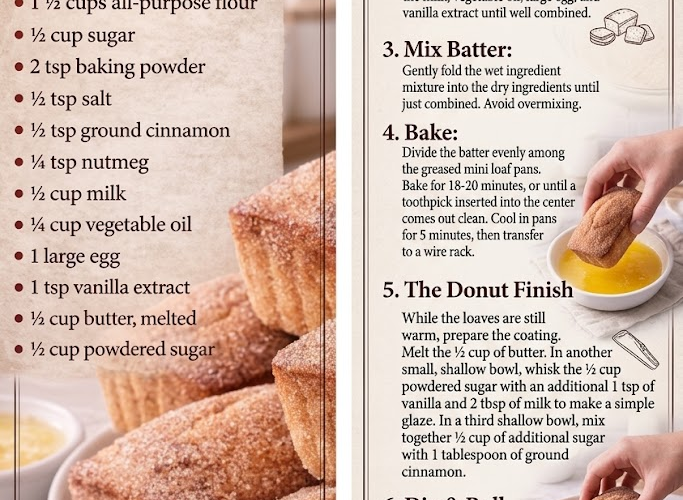
A classic cake donut relies on a few key elements: a soft, delicate crumb that melts in your mouth, a subtle hint of warm nutmeg, and that sweet, buttery sugar coating that clings to every single bite. Translating those qualities into a quick bread loaf yields all of that old-fashioned bakery nostalgia without needing a deep fryer.
The Science Behind the Texture & Flavor
- The Nutmeg Secret: What separates a plain cinnamon coffee cake from an old-fashioned “cake donut”? Nutmeg. Just a quarter teaspoon of nutmeg introduces a warm, slightly woody, aromatic depth that instantly signals “fresh donut” to your palate.
- Oil vs. Butter in the Batter: While butter is used for the outer coating, vegetable oil is crucial inside the batter. Oil remains liquid at room temperature, keeping the interior of the loaf soft, tender, and moist for days without turning dry or dense.
- The Warm-Loaf Butter Seal: Brushing the loaf with melted butter while it is still warm from the oven does two things: it melts the outer surface starches to create a sticky barrier for the sugar, and it seals moisture inside the loaf, keeping the crumb soft.
- Gentle Gluten Control: Overworking wheat flour develops gluten, which creates a chewy, bread-like structure. For a cake-donut texture, we fold the wet and dry ingredients just until combined to ensure the finished crumb breaks apart easily.
Complete Ingredients & Technical Quantities
Dry Mix Base:
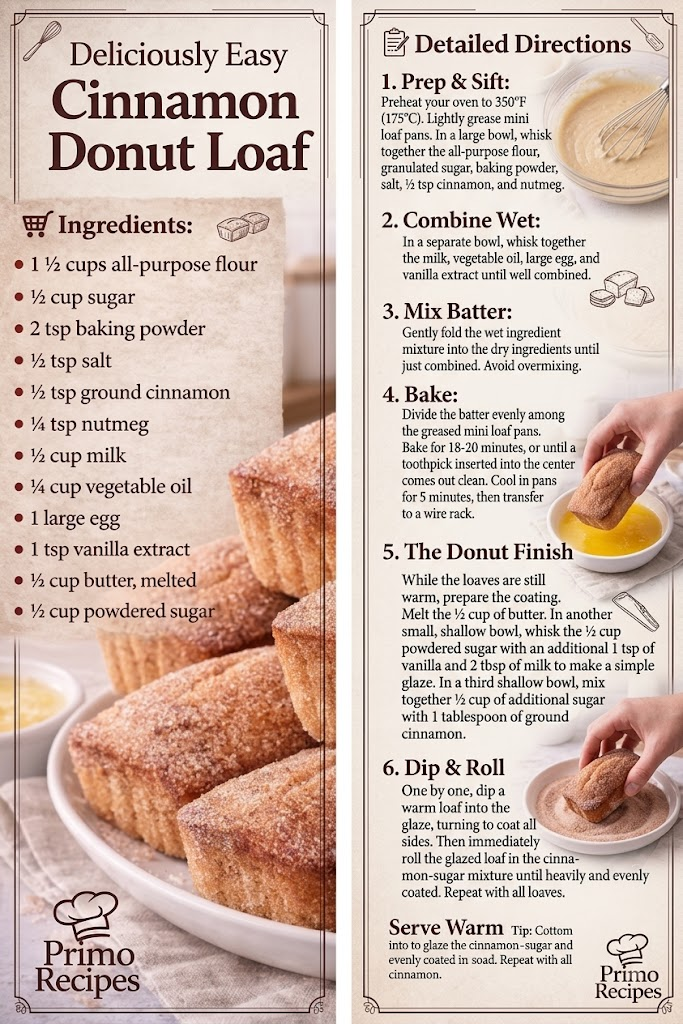
- 1 ½ cups (180 g) all-purpose flour, spooned and leveled
- ½ cup (100 g) granulated white sugar
- 2 teaspoons (8 g) baking powder
- ½ teaspoon (3 g) fine sea salt
- ½ teaspoon ground cinnamon
- ¼ teaspoon freshly grated nutmeg
Wet Emulsion Base:
- ½ cup (120 ml) whole milk, room temperature
- ¼ cup (60 ml) neutral vegetable oil (or canola oil)
- 1 large egg, room temperature
- 1 teaspoon pure vanilla extract
Donut Coating & Finish:
- ½ cup (1 stick / 115 g) unsalted butter, melted
- ½ cup (60 g) powdered sugar (for a tender, melt-in-your-mouth coating) OR ½ cup (100 g) granulated sugar mixed with 1 teaspoon cinnamon (for a classic bakery crunch)
Step-by-Step Master Instructions
1. Prep the Oven and Loaf Pans
- Preheat your oven to 350°F (175°C) with the rack set in the center position.
- Lightly grease a standard 9×5-inch loaf pan (or 3 to 4 mini loaf pans) with butter or cooking spray.
- Line the bottom and long sides with parchment paper, leaving a 2-inch overhang on the sides to create a “sling” for easy removal.
2. Whisk the Aerated Dry Base
In a large mixing bowl, whisk together the 1 ½ cups flour, ½ cup sugar, 2 tsp baking powder, ½ tsp salt, ½ tsp cinnamon, and ¼ tsp nutmeg. Whisking thoroughly for 30 seconds aerates the flour and ensures the baking powder and spices are evenly distributed.
3. Emulsify the Wet Ingredients
In a separate glass measuring cup or bowl, combine the ½ cup milk, ¼ cup vegetable oil, 1 large egg, and 1 tsp vanilla extract. Whisk vigorously until the egg is completely broken down and the liquid is uniform.
4. Combine and Fold Gently
Pour the wet mixture directly into the dry ingredients. Using a flexible silicone spatula, fold the ingredients together using gentle, sweeping motions. Stop the moment the white flour streaks disappear—the batter should be thick and slightly textured.
5. Bake Low and Slow
- Spoon the batter evenly into your prepared pan(s) and smooth the top.
- Bake at 350°F (175°C):
- For Mini Loaf Pans: Bake for 20 to 25 minutes.
- For a Standard 9×5 Pan: Bake for 35 to 45 minutes.
- The loaf is fully baked when the top is golden-brown, cracked down the center, and a wooden toothpick inserted into the thickest part comes out clean or with a few dry crumbs.
6. The Donut Shell Coating
- Let the loaf cool in the pan for 10 minutes, then use the parchment paper handles to gently lift it out onto a wire cooling rack set over a tray or paper towels.
- Melt the ½ cup butter in a shallow bowl. Place your chosen coating (powdered sugar or cinnamon-sugar) into a second shallow dish.
- While the loaf is still warm to the touch, generously brush the melted butter over the entire surface (top, sides, and bottom).
- Immediately roll or dust the buttery loaf with the sugar mixture, pressing gently so it sticks in a uniform layer.
Troubleshooting & Baker’s Matrix
| Issue | Likely Root Cause | How to Fix Next Time |
|---|---|---|
| Loaf turned out tough or rubbery | Overmixed the batter after combining wet and dry ingredients. | Fold just until flour streaks vanish; do not beat or whisk the finished batter. |
| Sugar coating melts/slides off | Applied butter/sugar while the loaf was piping hot, or didn’t use enough butter. | Let the loaf cool in the pan for 10 minutes first so the crust sets slightly before coating. |
| Loaf tastes flat or like standard cake | Omitted the nutmeg or reduced the salt. | Keep the nutmeg and salt intact—they provide the essential “cake-donut” flavor profile. |
| Loaf sank in the center | Underbaked in the middle, or opened the oven door repeatedly during baking. | Use a toothpick test in the center; avoid opening the oven before the 30-minute mark. |
Storage & Serving Tips
- Room Temperature: Keep the coated loaf stored in an airtight cake dome or wrapped loosely in foil at room temperature for up to 3 days. Avoid sealing it in plastic wrap while warm, as condensation can dissolve the sugar crust.
- Warm Serving Trick: Slice into thick rounds and microwave a slice for 8 to 10 seconds before eating. The interior turns soft and fluffy, and the sugar coating warms up to taste like it was just pulled from a bakery display case!