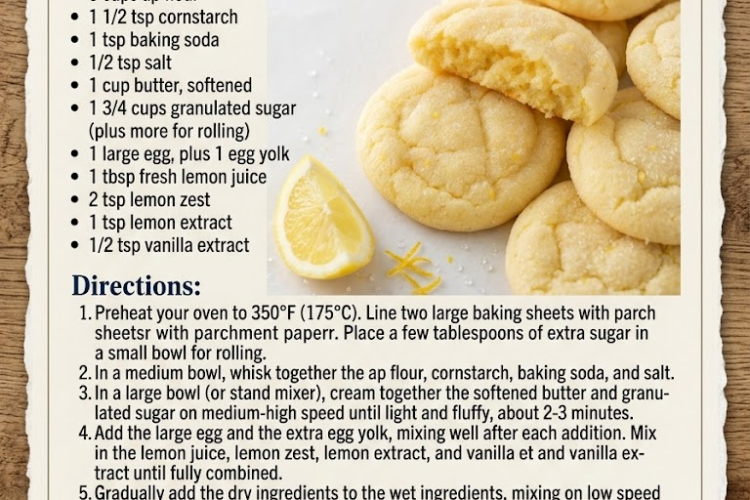
A truly great lemon sugar cookie shouldn’t taste like artificial candy or have the texture of a dry biscuit. It should be melt-in-your-mouth soft, with a subtle tang, a delicate crackled sugar crust, and an ultra-pillowy center.
Achieving that balance comes down to controlling the fat-to-protein ratio and extracting natural citrus oils directly into the sugar matrix before you ever turn on your mixer.
The Science Behind the Texture & Flavor
- Citrus Oil Extraction (Rubbed Sugar Method): Most of a lemon’s aromatic flavor lives in the essential oils trapped inside the outer yellow skin (the flavedo), not in the juice. Juice gives acid, but zest gives flavor. Rubbing fresh zest directly into granulated sugar uses the abrasive sugar crystals to burst those oil sacs, trapping the aromatic oils in the sugar so the lemon flavor bakes directly into the dough instead of evaporating off in the oven heat.
- The Extra Egg Yolk: Egg whites contain water and protein that cause cookies to rise and set firm (yielding a cakey texture). Egg yolks are pure fat and lecithin (an emulsifier). Adding one whole egg plus an extra yolk injects extra richness and moisture without adding structural protein, guaranteeing a dense, chewy, soft-baked center.
- Cornstarch as a Gluten Shield: All-purpose flour forms gluten when mixed with liquid. Cornstarch is a pure, gluten-free starch. Adding just 121 teaspoons of cornstarch weakens the overall gluten network just enough to keep the dough light, yielding a tender, delicate crumb that melts on your tongue.
- Baking Soda vs. Baking Powder: This recipe relies strictly on baking soda. Baking soda reacts with the natural acid in the fresh lemon juice, creating a quick burst of carbon dioxide gas that lifts the cookies while creating those classic, beautiful surface crinkles as they settle back down in the oven.
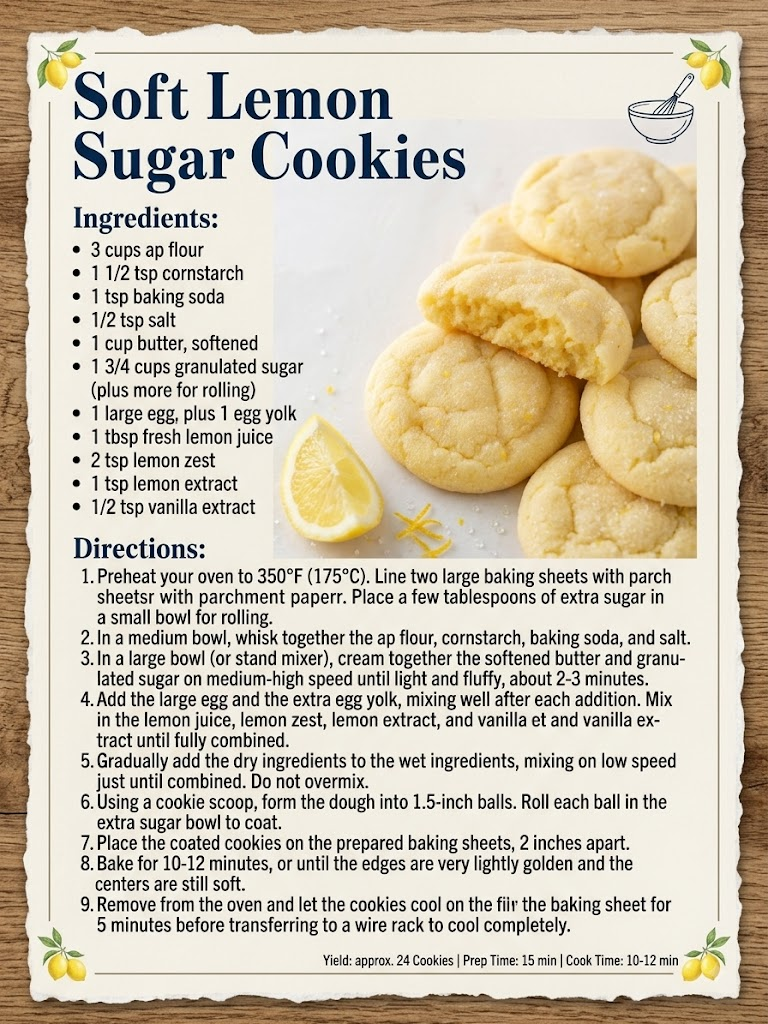
Ingredients & Technical Ratios
Dry Mix:
- 3 cups (360 g) all-purpose flour, spooned and leveled
- 1 ½ teaspoons (4.5 g) cornstarch
- 1 teaspoon (5 g) baking soda
- ½ teaspoon (3 g) fine sea salt
Fat & Emulsion Base:
- 1 cup (2 sticks / 226 g) unsalted butter, softened to true room temperature (65°F–68°F)
- 1 ¾ cups (350 g) granulated sugar (divided: 121 cups for dough, ¼ cup reserved for rolling)
- 1 large egg + 1 large egg yolk, room temperature
- 1 tablespoon (15 ml) freshly squeezed lemon juice
- 2 teaspoons (packed) freshly grated lemon zest (about 1 to 2 medium lemons)
- 1 teaspoon lemon extract (optional, but amplifies that bakery-style punch)
- ½ teaspoon pure vanilla extract
Step-by-Step Master Instructions
1. Infuse the Lemon Sugar Matrix
In your main mixing bowl (or the bowl of a stand mixer), combine the 121 cups granulated sugar and the 2 teaspoons fresh lemon zest.
Using clean fingertips, rub the zest into the sugar granules continuously for 60 to 90 seconds. The sugar will transform into a pale yellow, slightly damp, intensely aromatic citrus sugar.
2. Cream the Fat Base
Add the 1 cup softened unsalted butter directly to the lemon-infused sugar. Beat with a hand mixer or stand mixer fitted with the paddle attachment on medium-high speed for 2 to 3 minutes.
You are looking for a pale, fluffy consistency where the sugar granules are partially dissolved into the aerated butter fats.
3. Emulsify the Wet Ingredients
Lower the mixer speed to medium. Add the 1 whole egg, 1 egg yolk, 1 tablespoon lemon juice, 1 teaspoon lemon extract, and ½ teaspoon vanilla extract.
Beat for about 1 minute until completely smooth and emulsified. Scrape down the sides and bottom of the bowl with a silicone spatula to make sure no unmixed butter remains hidden at the bottom.
4. Sift and Bind Dry Ingredients
In a separate medium bowl, whisk together the 3 cups flour, 121 teaspoons cornstarch, 1 teaspoon baking soda, and ½ teaspoon salt.
Dump half of the dry mixture into the wet base and mix on low speed just until combined. Add the remaining dry ingredients and mix until the white streaks disappear. Stop immediately—overmixing at this stage will develop gluten and make the cookies tough instead of soft. The dough should feel soft, thick, and slightly tacky.
5. Chill the Dough (Mandatory Step)
Cover the bowl tightly with plastic wrap and place it in the refrigerator for at least 1 hour (2 to 3 hours is ideal).
Why Chilling is Non-Negotiable: Chilling solidifies the butter fats and allows the flour to fully hydrate. If you bake warm dough, the butter will melt instantly in the hot oven, causing the cookies to puddle into flat, greasy disks instead of holding their thick, pillowy structure.
6. Scoop, Roll, and Sugar-Coat
- Preheat your oven to 350°F (175°C) and line two large baking sheets with parchment paper or silicone baking mats.
- Place the remaining ¼ cup granulated sugar in a small, shallow bowl.
- Using a medium cookie scoop (about 1.5 tablespoons of dough per portion), roll the chilled dough between your palms into smooth, uniform spheres.
- Drop each ball into the bowl of sugar, rolling it around until completely covered in a sparkling layer of sugar crystals.
- Arrange the coated dough balls on your prepared baking sheets, leaving about 2 inches of space between them to allow for gentle spreading.
7. The Precision Bake
Bake at 350°F (175°C) for 10 to 12 minutes (check at the 10-minute mark).
The Visual Indicator for Softness: Do not wait for the tops to turn golden brown! These cookies are done when the edges look pale-golden and set, but the center still looks slightly puffed, soft, and underbaked. They will finish setting on the hot sheet off the heat.
8. Cool and Rest
Remove the pan from the oven and let the cookies rest undisturbed on the hot baking sheet for 5 minutes. Transfer them carefully to a wire cooling rack to finish cooling completely.
Troubleshooting & Baker’s Matrix
| Issue | Likely Root Cause | How to Fix Next Time |
|---|---|---|
| Cookies spread too flat and thin | Dough was too warm when entering the oven, or butter was melted instead of softened. | Ensure butter is soft but cool to the touch (65°F); chill shaped dough balls for 15 mins before baking. |
| Cookies turned out dense or cakey | Too much egg white used, or flour was scooped straight from the bag with a cup. | Always fluff flour with a fork and spoon it into measuring cups; stick strictly to 1 egg + 1 yolk. |
| Lack of lemon flavor after baking | Relied only on lemon juice, or skipped rubbing zest into the sugar. | Citrus juice loses punch under heat; always use fresh zest rubbed into sugar + lemon extract. |
| Bottoms browned/burned quickly | Dark, non-stick baking sheets absorbed too much radiant oven heat. | Use light-colored aluminum baking sheets lined with parchment paper. |
Storage & Freezing Guidelines
- Room Temperature Storage: Keep completely cooled cookies in an airtight container at room temperature for up to 1 week. Pro-tip: Toss a single slice of plain white sandwich bread into the container with the cookies. The cookies will pull moisture from the bread, keeping them soft and pillowy for days.
- Freezing Baked Cookies: Layer cooled cookies with parchment paper in a freezer-safe container and freeze for up to 3 months. Thaw at room temperature for 15 minutes before serving.
- Freezing Cookie Dough Balls: You can scoop, roll, and sugar-coat the dough balls, place them on a tray in the freezer for 1 hour until rock-solid, then transfer them to a zip-top freezer bag. Bake straight from frozen at 350°Ffor 12 to 14 minutes (no thawing needed!).