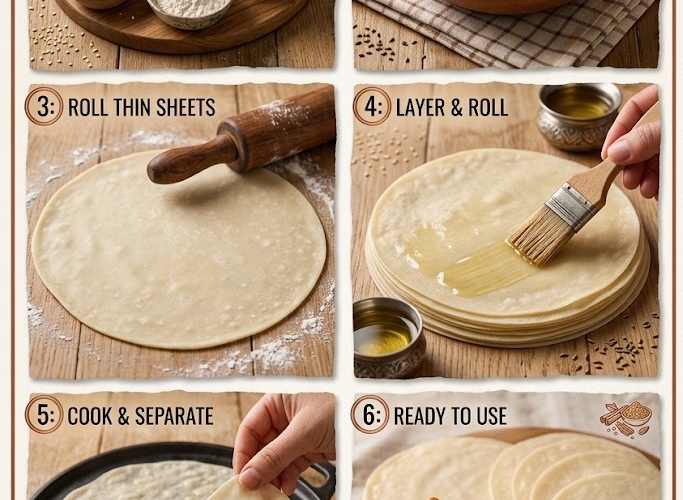
🥟 Perfect Homemade Samosa Sheets
These homemade samosa sheets are thin, pliable, and sturdy enough to hold generous fillings without tearing. Made with a simple flour dough and a light flour-and-oil layering mixture, they fry up beautifully crisp and golden.
Making your own sheets takes a little extra time, but the result is noticeably fresher and more satisfying than many store-bought wrappers.
⏱️ Recipe Information
Prep Time: 25 minutes
Resting Time: 30 minutes
Cook Time: 15 minutes
Total Time: About 1 hour 10 minutes
Yield: 10–12 samosa sheets
Difficulty: Intermediate
🛒 Ingredients
For the Dough
- 2 cups (250 g) all-purpose flour
- ½ teaspoon salt
- 2 tablespoons oil
- ¾ cup (180 ml) water, or as needed
For Layering
- 2 tablespoons all-purpose flour
- 2 tablespoons oil
For Rolling
- Extra all-purpose flour, as needed
Instructions
🥣 1. Make the Dough
Add the flour and salt to a large mixing bowl.
Pour in the 2 tablespoons oil.
Rub the oil into the flour with your fingertips until the mixture resembles coarse crumbs.
This step helps create tender, flexible samosa sheets.
💧 2. Add the Water
Gradually add the water while mixing.
You may not need all of it, so add it slowly.
Bring the mixture together until a firm but smooth dough forms.
The dough should not be sticky or overly soft.
✋ 3. Knead the Dough
Transfer the dough to a clean work surface.
Knead for approximately 6–8 minutes, until smooth and elastic.
If the dough feels dry, wet your hands slightly and continue kneading rather than adding large amounts of water.
⏲️ 4. Rest the Dough
Place the dough back in the bowl.
Cover with a clean kitchen towel or plastic wrap.
Allow it to rest for 30 minutes at room temperature.
Resting relaxes the gluten and makes the dough much easier to roll very thin without springing back.
🫓 5. Divide the Dough
After resting, divide the dough into approximately 10–12 equal portions.
Roll each portion into a smooth ball.
Keep the remaining dough balls covered while you work so they don’t dry out.
🥣 6. Make the Layering Paste
In a small bowl, combine:
- 2 tablespoons all-purpose flour
- 2 tablespoons oil
Mix until you have a smooth, spreadable paste.
This mixture will help create thin layers and make the sheets easier to separate after cooking.
🫓 7. Roll Two Dough Balls
Take two dough balls.
Lightly dust your work surface with flour.
Roll each ball into a thin circle approximately 5–6 inches (13–15 cm) in diameter.
Try to make both pieces as similar in size and thickness as possible.
🫒 8. Layer the Dough
Spread a very thin layer of the flour-and-oil paste over one rolled dough circle.
Place the second circle directly on top.
Press gently to remove any large air pockets.
You now have two layers stacked together.
Repeat this process with the remaining dough balls, working in pairs.
🔥 9. Cook the Layered Dough
Heat a dry skillet or tawa over medium-low heat.
Place one layered dough circle onto the pan.
Cook for approximately 20–30 seconds per side.
You’re not trying to fully cook or brown the dough.
The surface should simply become slightly firm and the layers should begin separating.
Overcooking at this stage can make the sheets brittle and difficult to fold.
🧻 10. Separate the Layers
Remove the warm layered dough from the pan.
While it is still warm, gently separate the two layers.
You should now have two thin samosa sheets.
If necessary, carefully loosen the edges with your fingertips.
🔪 11. Trim and Shape
Place the separated sheet on a cutting board.
Trim the edges if necessary to create a neat circle or rectangle.
For traditional triangular samosas, cut each sheet into approximately 2–3 long strips, depending on the size you want.
Keep finished sheets covered with a slightly damp, clean kitchen towel so they remain flexible.
🥟 12. Fill and Fold
Place your prepared samosa filling near one end of the sheet.
Fold the sheet diagonally over the filling to form a triangle.
Continue folding over itself until you reach the end.
Seal the final edge with a simple flour-and-water paste.
Repeat with the remaining sheets.
🍳 13. Fry the Samosas
Heat neutral oil in a deep, heavy-bottomed pan to approximately 325–350°F (165–175°C).
Carefully lower the filled samosas into the oil.
Fry in batches without overcrowding the pan.
Cook until golden brown and crisp, turning occasionally for even cooking.
Transfer to a paper towel-lined plate or wire rack to drain.
⭐ Chef’s Tips
Keep the Dough Firm
A soft, sticky dough is difficult to roll thin and can produce weak sheets.
Resting Is Essential
Don’t skip the 30-minute rest. Relaxed dough rolls much more easily.
Roll Thin, But Not Transparent
The sheets should be thin enough to fold easily but strong enough to contain the filling.
Keep Unused Dough Covered
Air quickly dries the surface and can cause cracks.
Don’t Brown the Sheets
The skillet step is only to partially cook and separate the layers.
Separate While Warm
The layers are much easier to peel apart while they’re still warm.
Don’t Overfill
Too much filling can stretch or tear the wrapper and make sealing difficult.
🥟 Troubleshooting
Sheets Tear While Rolling
The dough may be too dry or hasn’t rested enough.
Solution: Let it rest another 10–15 minutes and knead briefly if necessary.
Sheets Become Brittle
They were likely cooked too long in the skillet.
Solution: Cook them only until slightly firm.
Layers Don’t Separate
The flour-and-oil paste may have been applied too thinly.
Solution: Use a very thin but complete coating across the surface.
Samosas Open During Frying
The edges weren’t sealed properly.
Solution: Use a flour-and-water paste and press the seam firmly closed before frying.
🧊 Storage
Freshly prepared samosa sheets can be stacked with parchment paper between them.
Wrap tightly and refrigerate for up to 2 days.
Keep them covered so they don’t dry out.
❄️ Freezing
Place parchment between individual sheets and stack them.
Wrap tightly in plastic wrap and place inside a freezer-safe bag.
Freeze for up to 1 month.
Thaw in the refrigerator before using.
🥟✨ Recipe Summary
These Perfect Homemade Samosa Sheets are made with a simple flour dough that’s rested, rolled, layered with a flour-and-oil mixture, lightly cooked, and gently separated.
The finished sheets are thin, flexible, sturdy, and perfect for folding around your favorite savory filling.
Once fried, they become beautifully crisp and golden.
Homemade wrappers + your favorite samosa filling = crispy, fresh samosas made completely from scratch. 🥟🔥