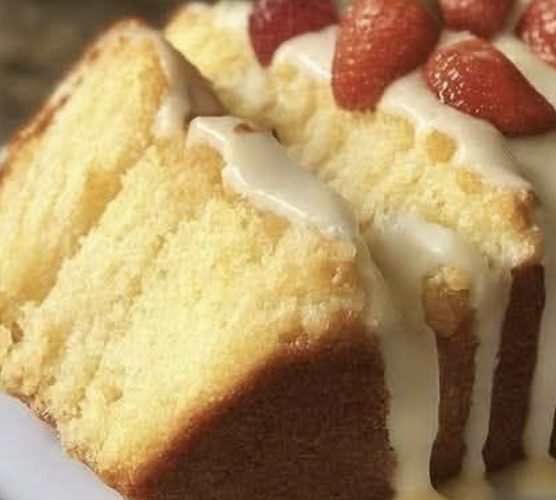
A true Lemon Buttermilk Pound Cake is the pinnacle of Southern baking: dense yet tender, richly buttery, and packed with bright, fragrant citrus oils. It is crowned with a glossy lemon-cream glaze and topped with fresh summer strawberries.
(Note: The text overlay in viral graphics often contains typos and nonsensical ingredients like duplicated flour, missing sugar, or “mustard powder.” Below is the authentic, professionally balanced masterclass recipe.)
The Science Behind a Velvety Pound Cake Crumb
- Buttermilk Lactic Acidity: The natural acid in buttermilk breaks down tough gluten strands in the flour, yielding a fine, tight crumb that stays moist for days without turning heavy or dry.
- Rubbing Lemon Zest into Sugar: Lemon essential oils (limonene) are trapped within the zest cells. Massaging the freshly grated lemon zest into granulated sugar with your fingertips causes the abrasive sugar crystals to rupture those cells, extracting and infusing the citrus oils throughout the entire batter rather than leaving it flat.
- The Emulsified Creaming Method: Beating room-temperature butter, cream cheese, and sugar together for 4 to 5 minutes incorporates microscopic air pockets. Adding room-temperature eggs one at a time builds a stable fat-in-water emulsion that prevents the batter from curdling or collapsing in the oven.
Complete Ingredients List
For the Lemon Pound Cake Batter:
- 3 cups (375 g) all-purpose flour (or cake flour for an even finer crumb)
- ½ teaspoon baking powder
- ½ teaspoon baking soda
- ½ teaspoon fine sea salt
- 1 cup (2 sticks / 225 g) unsalted butter, softened to room temperature
- ½ cup (4 oz / 115 g) brick cream cheese, softened
- 2 ½ cups (500 g) granulated white sugar
- 2 tablespoons freshly grated lemon zest (from 2–3 large lemons)
- 5 large eggs, room temperature
- 1 teaspoon pure vanilla extract
- 3 tablespoons fresh lemon juice
- 1 cup (240 ml) whole buttermilk, room temperature
For the Glossy Lemon-Vanilla Glaze:
- 1 ½ cups (180 g) powdered sugar, sifted
- 2 to 3 tablespoons fresh lemon juice
- 1 tablespoon heavy cream or whole milk
- ½ teaspoon pure vanilla extract
- Fresh strawberries, halved, for garnish
Step-by-Step Master Instructions
1. Prep the Pan and Oven
- Preheat your oven to 325°F (165°C) with the rack positioned in the center.
- Generously grease a standard 10-to-12-cup Bundt pan or two 9×5-inch loaf pans with butter and flour (or baking spray with flour), making sure to coat every ridge thoroughly.
2. Citrus-Sugar Infusion & Dry Mix
- In a medium bowl, combine the 2 ½ cups granulated sugar and 2 tablespoons lemon zest. Use your clean fingertips to rub the zest into the sugar for 1 to 2 minutes until moist and intensely fragrant.
- In a separate bowl, whisk together the 3 cups flour, ½ tsp baking powder, ½ tsp baking soda, and ½ tsp salt. Set aside.
3. Cream the Fats and Emulsify
- In the bowl of a stand mixer fitted with the paddle attachment, beat the 1 cup softened butter and ½ cup cream cheese on medium-high speed for 2 minutes until smooth and creamy.
- Pour in the infused lemon sugar. Beat on medium-high for 4 to 5 minutes until the mixture is pale, light, and fluffy.
- Add the 5 eggs one at a time, beating for 30 seconds after each addition. Stir in the 1 tsp vanilla extract and 3 tbsp lemon juice.
4. Combine Dry & Wet Alternately
- Set the mixer to low speed.
- Add one-third of the dry flour mixture, followed by half of the 1 cup buttermilk. Repeat with the next third of flour, the rest of the buttermilk, and finish with the final third of flour.
- Mix just until the flour streaks disappear. Do not overmix, as excess agitation develops gluten and toughens the crumb.
5. Precision Bake
- Pour the thick batter into your prepared pan(s) and smooth the top with an offset spatula. Tap the pan lightly on the counter once to release large trapped air pockets.
- Bake at 325°F (165°C) for 60 to 75 minutes for a Bundt/large loaf (or 50 to 55 minutes for two standard loaves).
- The cake is done when a long wooden skewer inserted into the thickest part comes out clean or with a few moist crumbs (no wet batter).
6. Cool, Glaze, and Garnish
- Let the cake rest in the pan on a wire cooling rack for 15 minutes.
- Invert the cake onto the wire rack to cool completely to room temperature.
- In a small bowl, whisk together the 1 ½ cups powdered sugar, 2 to 3 tbsp lemon juice, 1 tbsp heavy cream, and ½ tsp vanilla until thick, glossy, and pourable.
- Spoon the glaze generously over the cooled cake, letting it drip down the sides. Top with fresh halved strawberries and let the glaze set for 10 minutes before slicing.
Baker’s Troubleshooting & Precision Matrix
| Issue | Root Cause | Practical Fix |
|---|---|---|
| Cake stuck in the pan ridges | Pan was insufficiently greased, or inverted while either screaming hot or completely cold. | Use baking spray with flour; turn cake out precisely at the 15-minute cooling mark. |
| Crumb is dense, gummy, or wet in center | Underbaked, or cold ingredients caused the batter emulsion to split. | Bring all butter, eggs, cream cheese, and buttermilk to room temperature before mixing. |
| Glaze melted and disappeared | Glaze was poured while the cake was still warm. | Allow the cake to cool completely to room temperature before icing. |
| Top cracked open deeply | Normal for dense pound cakes, but overly deep craters indicate oven temperature was too high. | Bake at a steady 325°F (165°C) to ensure slow, even heat penetration. |
Storage & Serving
- Room Temperature: Store the glazed cake under a cake dome or wrapped tightly in foil at room temperature for up to 4 days. The crumb becomes even more tender and moist on day two.
- Freezing: Wrap unglazed, cooled pound cake slices (or the whole cake) tightly in plastic wrap and aluminum foil, then freeze for up to 3 months. Thaw at room temperature and glaze fresh before serving.