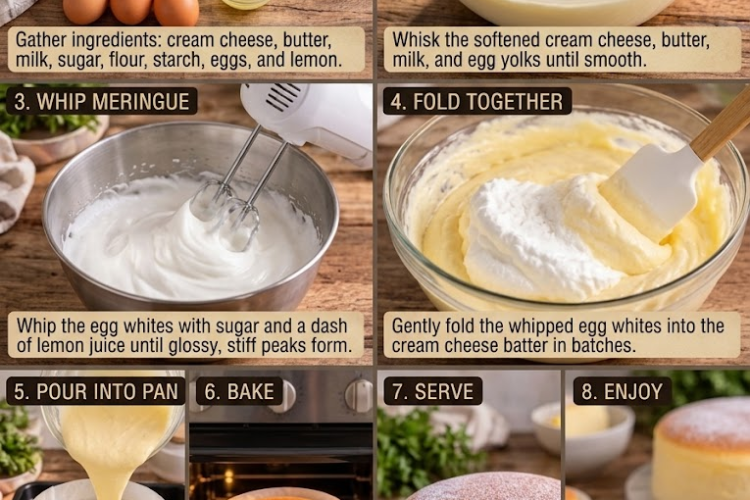
🇯🇵🍰 Japanese Cotton Cheesecake
This Japanese Cotton Cheesecake is incredibly light, airy, and delicate, with a creamy cheesecake flavor and a wonderfully soft, cloud-like texture. Unlike traditional dense cheesecake, this Japanese-style version is gently folded with whipped egg whites and baked in a water bath, creating its famous jiggly, melt-in-your-mouth crumb.
It’s elegant enough for celebrations but simple enough to enjoy with afternoon tea or coffee.
Recipe Information
- Preparation Time: 20 minutes
- Baking Time: 60 minutes
- Cooling Time: 1–2 hours
- Total Time: About 2 hours 20 minutes
- Servings: 8
- Difficulty: Moderate
- Pan: 8-inch (20 cm) round deep cake pan
- Method: Water-bath baking
Ingredients
For the Cheesecake Batter
- 250 g cream cheese, softened
- 6 large eggs, separated
- ½ cup (100 g) granulated sugar, divided
- ¼ cup (60 g) unsalted butter
- 100 ml whole milk
- ½ cup (60 g) cake flour
- 2 tablespoons (20 g) cornstarch
- 1 tablespoon (15 ml) fresh lemon juice
- 1 teaspoon vanilla extract
For the Meringue
- 6 large egg whites
- ¼ teaspoon cream of tartar
For the Water Bath
- Hot water, as needed
Instructions
1. Prepare the Pan and Oven
Preheat your oven to 320°F (160°C).
Line the bottom of an 8-inch (20 cm) deep round cake pan with parchment paper.
Lightly grease the sides of the pan and line them with parchment as well, allowing the paper to extend slightly above the rim if your pan is not especially deep.
Wrap the outside bottom and sides of the pan securely with 2 layers of aluminum foil to prevent water from entering during the water bath.
Place a larger roasting pan nearby for the water bath.
2. Prepare the Cream Cheese Mixture
Place the softened cream cheese, butter, and milk in a heatproof bowl.
Set the bowl over a saucepan of gently simmering water, making sure the bottom of the bowl does not touch the water.
Whisk gently until the cream cheese and butter have completely melted and the mixture is smooth and creamy.
Remove from the heat.
3. Add the Egg Yolks
Allow the cream cheese mixture to cool slightly.
Add the egg yolks one at a time, whisking well after each addition.
Add the lemon juice and vanilla extract.
Whisk until smooth and fully combined.
4. Sift in the Dry Ingredients
Sift the cake flour and cornstarch together.
Add them gradually to the cream cheese mixture.
Whisk gently until there are no visible lumps.
Do not overmix.
For an especially smooth cheesecake, strain the batter through a fine-mesh sieve into a clean bowl.
5. Prepare the Meringue
Place the egg whites in a completely clean and dry mixing bowl.
Add the cream of tartar.
Begin beating on medium speed until the whites become foamy.
Gradually add the remaining ½ cup (100 g) sugar in several additions while continuing to beat.
Increase to medium-high speed and whip until the meringue reaches soft to medium peaks.
When the whisk is lifted, the peak should stand but gently bend at the tip.
Do not whip the egg whites until they are extremely stiff and dry. A softer meringue folds more easily into the cheesecake batter and produces a smoother, more delicate texture.
6. Fold the Meringue into the Batter
Add about one-third of the whipped egg whites to the cream cheese batter.
Fold gently with a rubber spatula to lighten the mixture.
Add another third and fold carefully.
Add the final third and continue folding until the batter is evenly combined.
Use broad, gentle folding motions from the bottom of the bowl upward.
Avoid stirring vigorously, as this will knock out the air you’ve incorporated into the meringue.
7. Pour into the Pan
Pour the batter into the prepared cake pan.
Gently tap the pan once or twice on the counter to release any large air bubbles.
Smooth the surface with a spatula if necessary.
8. Prepare the Water Bath
Place the cake pan inside the larger roasting pan.
Carefully pour hot water into the roasting pan until it reaches approximately 1 inch (2–3 cm) up the sides of the cake pan.
The water bath provides gentle, even heat and helps prevent the cheesecake from drying out or cracking.
9. Bake
Place the roasting pan carefully in the center of the oven.
Bake at 320°F (160°C) for 20 minutes.
Reduce the oven temperature to 285°F (140°C) and continue baking for approximately 35–40 minutes, or until the cake has risen, the top is lightly golden, and the center has a gentle jiggle.
If the top begins browning too quickly, loosely place a sheet of aluminum foil over the cake.
10. Let the Cake Cool Gradually
Turn off the oven and leave the cheesecake inside with the oven door slightly open for approximately 10–15 minutes.
This gradual cooling helps reduce the chance of the cake shrinking dramatically or collapsing.
Remove the cheesecake from the water bath.
Carefully remove the foil from around the pan.
Allow the cake to cool in the pan for another 20–30 minutes.
11. Remove from the Pan
Once the cheesecake is cool enough to handle, gently loosen the edges with a thin knife or cake spatula.
Place a plate or cooling rack over the pan and carefully invert the cake.
Remove the parchment paper.
Then gently turn the cheesecake upright onto a serving plate.
Handle it carefully—the cake will be extremely soft and delicate while warm.
12. Chill and Serve
For a slightly firmer texture, refrigerate the cheesecake for at least 1 hour before slicing.
Use a sharp knife to cut clean slices.
For especially neat slices, wipe the knife clean between cuts.
Serve chilled or slightly cool.
Chef’s Tips
- Use room-temperature cream cheese and eggs: They blend more easily and help create a smooth batter.
- Sift the flour and cornstarch: This helps prevent lumps and keeps the batter light.
- Don’t overbeat the egg whites: Stiff, dry meringue is harder to fold in and can contribute to cracking or a coarse texture.
- Fold gently: The air in the meringue is what gives this cheesecake its signature cotton-soft texture.
- Use a water bath: It provides gentle moisture and helps the cake bake evenly.
- Don’t open the oven too early: Sudden temperature changes can cause the cheesecake to collapse.
- Cool gradually: A gradual temperature change helps minimize shrinkage.
- Don’t overbake: The center should still have a gentle jiggle when the cheesecake is ready.
How to Tell When It’s Done
The cheesecake should:
- Have a lightly golden surface.
- Feel set around the edges.
- Have a slight jiggle in the center.
- Spring back gently when very lightly touched.
Avoid waiting for the center to become completely firm in the oven. It will continue setting as it cools.
Delicious Variations
Matcha Japanese Cotton Cheesecake
Replace 1 tablespoon of the cake flour with 1 tablespoon matcha powder.
Chocolate Cotton Cheesecake
Replace 2 tablespoons of the cake flour with 2 tablespoons unsweetened cocoa powder and add a little extra sugar to taste.
Orange Cheesecake
Replace the lemon juice with 1 tablespoon fresh orange juice and add 1 teaspoon finely grated orange zest.
Berry Cheesecake
Serve with fresh strawberries, blueberries, or raspberries and a light dusting of powdered sugar.
Lemon Glaze
Drizzle the cooled cheesecake with a simple glaze made from powdered sugar and fresh lemon juice.
Serving Suggestions
Japanese Cotton Cheesecake is delicious with:
- Fresh berries
- Powdered sugar
- Whipped cream
- Strawberry sauce
- Raspberry sauce
- Lemon curd
- Matcha powder
- Vanilla ice cream
- Fresh fruit
It’s especially lovely served alongside a cup of Japanese green tea, black tea, coffee, or matcha latte.
Storage
Store the cheesecake covered in the refrigerator for up to 4 days.
Keep it chilled until ready to serve.
Freezing
The cheesecake can be frozen for up to 1 month.
Wrap individual slices tightly in plastic wrap and place them in an airtight freezer-safe container.
Thaw overnight in the refrigerator before serving.
Troubleshooting
Why did my cheesecake collapse?
A little shrinkage is normal, but dramatic collapse can happen if the meringue was overbeaten, the batter was overmixed, or the cake was cooled too quickly.
Why did it crack?
The oven may have been too hot, or the cake may have baked too close to the top heating element. The water bath and lower baking temperature help prevent this.
Why is my cheesecake dense?
The most common cause is losing too much air from the whipped egg whites. Fold gently and avoid overmixing.
Why is the bottom wet?
Make sure the cake pan is tightly wrapped in foil and that the water bath is not filled too high.
Final Result
A beautifully light and delicate Japanese Cotton Cheesecake with a golden top, soft creamy interior, gentle jiggle, and an almost cloud-like texture. Every bite practically melts in your mouth, making this one of the most irresistible cheesecake styles to bake at home.