🍰 Japanese Castella Cake
This Japanese Castella Cake is a beautifully soft, airy sponge cake with a delicate honey sweetness, a golden top, and a moist, tender crumb. Made with simple ingredients like eggs, flour, sugar, milk, and honey, it is an elegant homemade treat that pairs perfectly with tea or coffee.
The secret to a light Castella-style cake is whipping the eggs and sugar until thick and airy, then gently folding in the flour and liquids without losing the air that gives the cake its beautiful texture.
Recipe Information
- Prep Time: 20 minutes
- Bake Time: 45–55 minutes
- Cooling Time: 30–45 minutes
- Total Time: Approximately 1 hour 45 minutes
- Servings: 8–10 slices
- Difficulty: Moderate
- Method: Oven-baked
- Pan: 8-inch (20 cm) square cake pan, preferably deep
Ingredients
- 6 large eggs, at room temperature
- 1 cup (125 g) all-purpose flour, sifted
- ¾ cup (150 g) granulated sugar
- ¼ cup (60 ml) whole milk
- ¼ cup (60 ml) vegetable oil
- 3 tablespoons (63 g) honey
- 1 teaspoon vanilla extract
- ¼ teaspoon salt
For Preparing the Pan
- Parchment paper
- A little neutral oil, if needed
Instructions
1. Prepare the Oven and Pan
Preheat your oven to 325°F (160°C).
Line the bottom and sides of an 8-inch (20 cm) square cake pan with parchment paper, allowing a little extra paper to extend above the sides.
Make sure the paper sits flat against the pan.
Set the prepared pan aside.
2. Prepare the Honey Mixture
In a small bowl, combine the milk, vegetable oil, honey, and vanilla extract.
Warm the mixture gently for a few seconds, just until the honey loosens and blends easily with the other ingredients. It should be lukewarm, not hot.
Whisk until smooth and set aside.
3. Beat the Eggs and Sugar
Place the eggs and granulated sugar in a large, clean mixing bowl.
Using a hand mixer or stand mixer, beat on medium-high speed for approximately 6–10 minutes, depending on your mixer.
Continue until the mixture becomes pale, thick, and significantly increased in volume.
When you lift the beaters, the batter should fall in thick ribbons that remain visible on the surface for a few seconds before disappearing.
This ribbon stage is essential because the incorporated air gives the cake its light, delicate structure.
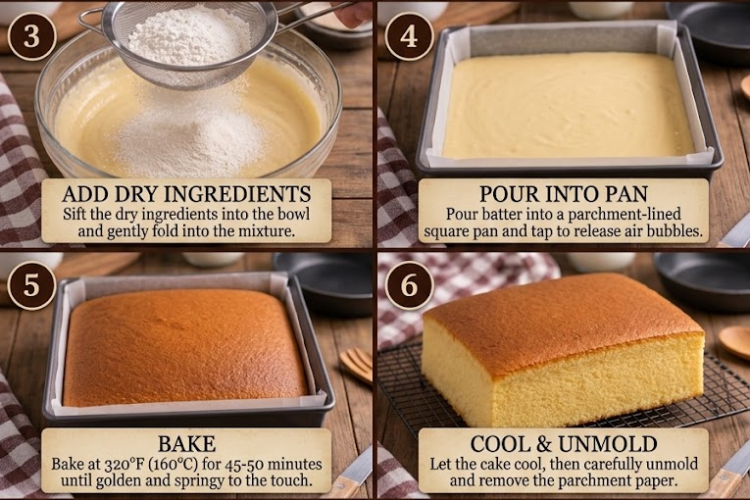
4. Sift the Flour
Sift the flour and salt together.
Add the mixture to the whipped eggs in two or three additions.
Using a rubber spatula, gently fold the flour into the batter with broad movements from the bottom of the bowl upward.
Rotate the bowl as you fold, and stop as soon as no dry flour remains.
Avoid vigorous stirring, which can deflate the eggs and make the cake dense.
5. Incorporate the Honey Mixture
The milk and oil mixture is heavier than the whipped egg batter, so it should be added gently.
Transfer about ½ cup of the cake batter into the bowl containing the honey mixture.
Whisk gently until the two mixtures are combined.
Pour this lighter mixture back into the main batter in a slow, thin stream while folding gently with a spatula.
Continue folding just until the batter is uniform.
Try not to overmix or knock out too much air.
6. Pour the Batter into the Pan
Pour the batter into the prepared cake pan.
Gently tap the pan on the countertop once or twice to release any large air bubbles.
If small bubbles remain on the surface, gently pop them with a skewer.
Smooth the surface carefully with a spatula.
7. Bake the Cake
Place the pan on the center rack of the preheated oven.
Bake for approximately 45–55 minutes, or until the top is golden brown and the cake is set.
To check for doneness:
- The top should spring back lightly when gently touched.
- A skewer inserted into the center should come out clean or with a few moist crumbs.
- The center should not wobble when the pan is moved gently.
Avoid opening the oven during the first 30 minutes of baking, as a sudden drop in temperature can cause the cake to sink.
If the top browns too quickly, loosely cover it with aluminum foil for the remaining baking time.
8. Brush with Extra Honey (Optional)
For a shinier, slightly sweeter finish, mix 1 teaspoon honey with 1 teaspoon warm water.
Brush a very thin layer over the top of the cake while it is still warm.
This step is optional, but it enhances the honey aroma and gives the crust a delicate sheen.
9. Cool the Cake
Remove the cake from the oven and let it cool in the pan for approximately 10–15 minutes.
Carefully lift it out using the parchment paper and transfer it to a wire rack.
Allow it to cool completely before slicing.
For a more traditional Castella-style texture, wrap the completely cooled cake tightly and refrigerate it for several hours or overnight. This allows the honey flavor to develop and helps the crumb become moist and even.
10. Slice and Serve
Place the cooled cake on a cutting board.
Trim the edges if desired for a neat presentation, then cut it into thick rectangular slices using a sharp serrated knife.
Wipe the knife between cuts for cleaner slices.
Serve at room temperature with tea, coffee, or a glass of milk.
Chef’s Tips
- Use room-temperature eggs: They whip more easily and produce a greater volume.
- Beat to the ribbon stage: The egg-and-sugar mixture should become pale, thick, and airy.
- Sift the flour: This helps prevent lumps and makes folding easier.
- Fold gently: Overmixing removes air and can leave the cake dense.
- Temper the honey mixture with batter: Mixing a little batter into the liquids first makes them easier to incorporate without deflating the eggs.
- Don’t overbake: Excessive baking can dry out the sponge and make the edges hard.
- Avoid opening the oven too early: The cake needs a stable temperature while its structure sets.
- Allow the cake to cool fully: Warm Castella-style cake is delicate and can compress when sliced.
- For deeper honey flavor: Let the fully cooled cake rest, wrapped, in the refrigerator overnight before serving.
Delicious Variations
🍯 Extra-Honey Castella Cake
Add 1 additional tablespoon honey to the milk mixture for a deeper honey aroma and slightly sweeter flavor.
🍋 Lemon Castella Cake
Add 1 teaspoon finely grated lemon zest to the egg mixture for a bright citrus note that balances the sweetness.
🍵 Matcha Castella Cake
Replace 1 tablespoon of the flour with 1 tablespoon matcha powder, sifted together with the remaining flour.
🍫 Chocolate Castella-Style Cake
Replace 2 tablespoons of flour with 2 tablespoons unsweetened cocoa powder. Sift them together before folding into the whipped eggs.
☕ Coffee-Honey Cake
Dissolve 1 teaspoon instant espresso powder in the warm milk before combining it with the oil and honey.
🍊 Orange Castella Cake
Add 1 teaspoon finely grated orange zest and replace 1 tablespoon of the milk with fresh orange juice.
Make-Ahead Instructions
This cake is excellent for making ahead.
Bake it a day before serving, cool it completely, and wrap it tightly to retain moisture.
Refrigerate overnight for a more settled crumb and developed honey flavor.
Allow the cake to come closer to room temperature before serving for the softest texture.
Storage
Store the completely cooled cake in an airtight container at room temperature for up to 2 days, provided your kitchen is cool.
For longer storage, refrigerate for up to 5 days. Keep it tightly wrapped to prevent it from drying out, and allow slices to soften slightly at room temperature before serving.
Freezing
Wrap the cooled cake tightly in plastic wrap, then place it in a freezer-safe container or bag.
Freeze for up to 2 months for the best quality.
Thaw overnight in the refrigerator or at room temperature while still wrapped to help retain moisture.
Serving Suggestions
This honey sponge cake pairs beautifully with:
- Japanese green tea
- Black tea
- Matcha latte
- Coffee or cappuccino
- Fresh strawberries
- Whipped cream
- Vanilla ice cream
- A light drizzle of honey
- Fresh berries and yogurt
For a simple, elegant presentation, serve thick slices on their own with a cup of warm tea.
Final Result
A beautifully soft Japanese Castella-Style Honey Cake with a golden top, delicate sponge texture, and a gentle sweetness from honey and vanilla. Light, tender, and wonderfully aromatic, it’s a lovely homemade cake for afternoon tea, family gatherings, or any occasion that calls for a simple yet elegant dessert.