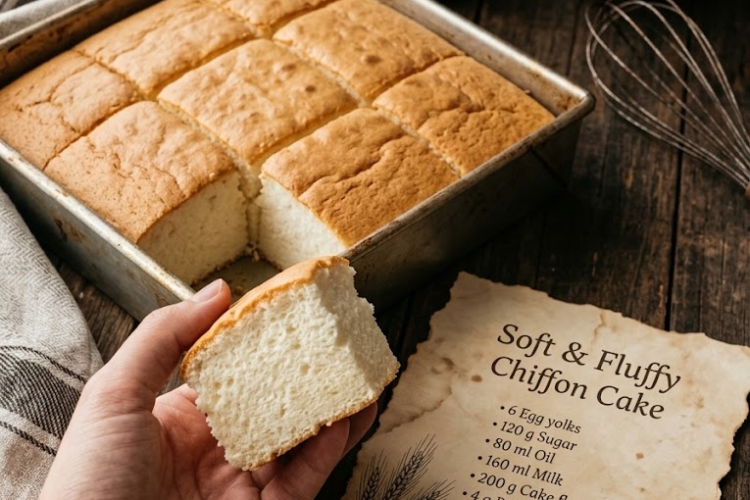
🍰 Easy Chiffon Cake (Soft, Light & Fluffy)
This Easy Chiffon Cake is wonderfully soft, airy, and delicate, with a tender crumb that practically melts in your mouth. Made with egg yolks, fresh milk, vanilla, and vegetable oil, this classic-style cake combines the richness of a butter cake with the light, cloud-like texture of a sponge cake.
The secret lies in whipping the egg whites into a glossy meringue and gently folding it into the batter. The result is a beautifully tall cake with a fine, fluffy texture and a subtle vanilla flavor. It’s delicious served plain with tea or coffee, or dressed up with whipped cream, fresh berries, or a light dusting of powdered sugar.
Recipe Information
- Prep Time: 25 minutes
- Bake Time: 50–60 minutes
- Cooling Time: 1–2 hours
- Total Time: Approximately 2 hours 30 minutes
- Yield: 1 tall chiffon cake
- Servings: 8–10 slices
- Course: Dessert, Snack
- Difficulty: Moderate
Ingredients
For the Chiffon Cake Batter
- 6 large egg yolks, at room temperature
- 120 g granulated sugar
- 4 g vanilla powder, or 2 teaspoons vanilla extract
- 80 ml neutral vegetable oil
- 160 ml fresh milk, at room temperature
- 200 g cake flour, sifted
- 4 g baking powder
- 4 g salt
For the Meringue
- 6 large egg whites, at room temperature
- 120 g granulated sugar
- ½ teaspoon cream of tartar, or 1 teaspoon lemon juice
Equipment: An 8-inch (20 cm) chiffon cake tube pan with a removable base is ideal. Use a completely clean, dry bowl for the egg whites.
Instructions
Step 1: Prepare the Oven and Pan
Preheat the oven to 160°C (320°F). Position the oven rack in the lower-middle section of the oven.
Prepare an 8-inch chiffon cake pan. Do not grease or line the pan with parchment paper. The batter needs to cling to the sides as it rises, helping the cake achieve its characteristic height.
Make sure your mixing bowls and beaters are clean and free of grease.
Step 2: Separate the Eggs
Carefully separate the 6 eggs, placing the yolks in one large mixing bowl and the whites in another.
Make sure no yolk enters the egg whites. Even a small amount of yolk can make it difficult to whip the whites into a stable meringue.
Set the eggs aside while preparing the batter.
Step 3: Mix the Egg Yolks and Sugar
Add the 120 g granulated sugar to the egg yolks.
Whisk for approximately 1–2 minutes until the mixture becomes smooth and slightly lighter in color.
Add the vanilla powder and whisk again until evenly incorporated.
Step 4: Add the Oil and Milk
Pour the vegetable oil into the yolk mixture in a slow stream while whisking continuously.
Once combined, add the fresh milk and whisk until the mixture looks smooth and uniform.
The oil adds moisture and tenderness, while the milk gives the cake a delicate flavor and soft texture.
Step 5: Sift and Add the Dry Ingredients
In a separate bowl, sift together the cake flour, baking powder, and salt.
Add the dry ingredients to the egg yolk mixture in two or three additions, whisking gently after each addition until smooth.
Scrape the sides and bottom of the bowl to ensure no dry flour remains.
Avoid vigorous mixing once the flour is incorporated. The batter should be smooth, fairly thick, and free of large lumps.
Step 6: Prepare the Meringue
Place the egg whites in a clean, dry mixing bowl. Add the cream of tartar or lemon juice.
Using an electric mixer, beat on medium speed until the whites become foamy and form soft peaks.
Gradually add the 120 g granulated sugar, approximately one tablespoon at a time, while continuing to beat.
Once all the sugar has been added, increase the speed to medium-high and beat until the meringue forms glossy, firm peaks.
When you lift the beaters, the peaks should stand upright with only a slight bend at the tip. The meringue should look smooth and shiny, not dry or clumpy.
Important: Do not overbeat the egg whites. Dry, grainy meringue is harder to fold into the batter evenly and can produce a coarse cake texture.
Step 7: Lighten the Cake Batter
Add approximately one-third of the meringue to the egg yolk batter.
Using a spatula or whisk, gently fold it in until the mixture becomes lighter and easier to combine.
This first addition loosens the yolk batter, making it easier to incorporate the remaining meringue without losing too much air.
Step 8: Fold in the Remaining Meringue
Add half of the remaining meringue and gently fold it into the batter using a spatula.
Move the spatula down through the center of the bowl, sweep along the bottom, and lift the batter over the top while turning the bowl.
Add the final portion of meringue and continue folding until the batter is evenly colored with no obvious white streaks.
Try to preserve as much air as possible. Avoid stirring in circles or mixing too vigorously, as this can deflate the meringue and result in a dense cake.
Step 9: Transfer the Batter to the Pan
Pour the batter into the ungreased chiffon pan.
Use a spatula to spread it evenly. Gently run a skewer through the batter in a circular motion to help release large air pockets, then lightly smooth the surface.
Tap the pan very gently only if necessary. Avoid repeatedly banging it on the counter, as this can remove some of the air needed for a fluffy texture.
Step 10: Bake the Chiffon Cake
Place the pan in the preheated oven and bake at 160°C (320°F) for 50–60 minutes.
Avoid opening the oven door during the first 40 minutes, as a sudden temperature change can cause the cake to collapse.
The cake is ready when the top is golden, the center springs back gently when touched, and a skewer inserted into the middle comes out without wet batter.
If the surface is browning too quickly while the center remains underbaked, reduce the oven temperature slightly and continue baking until done.
Step 11: Invert the Cake Immediately
Remove the cake from the oven and immediately turn the pan upside down.
If your chiffon pan has feet, rest the pan on those feet. Otherwise, invert it over the neck of a sturdy bottle or another safe support that allows air to circulate without crushing the cake.
Leave the cake inverted until it has cooled completely, usually 1–2 hours.
Do not skip this step. Chiffon cake is very light and can shrink or collapse under its own weight if left upright while warm.
Step 12: Remove the Cake from the Pan
Once completely cool, turn the pan upright.
Carefully run a thin knife or offset spatula around the outer edge of the cake and around the central tube. Release the removable base and gently separate the cake from the bottom.
Invert it onto a serving plate and lift away the pan base.
Handle the cake gently so its delicate crumb and tall shape remain intact.
Step 13: Slice and Serve
Use a serrated knife to cut the cake into slices, using a gentle sawing motion rather than pressing down firmly.
Serve plain to enjoy the delicate vanilla flavor, or finish with powdered sugar, lightly sweetened whipped cream, fresh strawberries, or your favorite fruit.
Chef’s Tips for the Softest Chiffon Cake
- Measure ingredients accurately: Baking is sensitive to ratios, especially in delicate cakes. Use a kitchen scale whenever possible.
- Use cake flour: Its lower protein content helps create a fine, tender crumb. If substituting all-purpose flour, the texture may be slightly firmer.
- Keep the pan ungreased: The batter needs to grip the sides as it rises.
- Prevent yolk contamination: Even a little fat in the egg whites can interfere with meringue formation.
- Beat to firm, glossy peaks: Underwhipped whites may not support the cake, while overwhipped whites can become dry and difficult to fold.
- Fold gently: Maintaining the air in the meringue is essential for the cake’s height and softness.
- Don’t underbake: A cake that is not fully set may collapse as it cools.
- Invert immediately: Cooling upside down helps preserve the cake’s structure.
- Cool completely before cutting: The crumb needs time to stabilize, making the cake easier to slice without compressing it.
Delicious Variations
Chocolate Chiffon Cake
Replace 25–30 g of the cake flour with unsweetened cocoa powder, adjusting the flour amount accordingly. Sift the cocoa thoroughly with the remaining dry ingredients.
Lemon Chiffon Cake
Add 1 tablespoon finely grated lemon zest to the yolk mixture and replace a small portion of the milk with lemon juice for a fresh citrus variation.
Pandan Chiffon Cake
Add 1–2 teaspoons pandan extract to the yolk mixture. Reduce the milk slightly if your extract is very liquid, and adjust the flavoring to taste.
Orange Vanilla Chiffon Cake
Add 1 tablespoon finely grated orange zest and use vanilla extract for a fragrant, citrus-infused cake.
Coconut Chiffon Cake
Replace part of the fresh milk with coconut milk for a subtle coconut flavor. Use a moderate amount so the batter consistency remains similar.
Strawberry Cream Chiffon Cake
Serve slices with whipped cream and fresh strawberries, or use the cooled chiffon cake as a light base for a layered cream cake.
Make-Ahead Instructions
Chiffon cake can be baked a day ahead. Allow it to cool completely, then store it in an airtight container or cover it securely to prevent the cake from drying out.
For the best texture, wait until the cake has cooled fully before wrapping it. Avoid refrigerating an undecorated cake unnecessarily, as refrigeration can make the crumb firmer.
If adding whipped cream or fresh fruit, decorate shortly before serving.
Storage Instructions
Room Temperature: Store the completely cooled, undecorated cake in an airtight container for up to 2 days in a cool environment.
Refrigerator: If topped with whipped cream or fresh fruit, refrigerate it in a covered container and consume within 2–3 days.
Freezer: Wrap individual slices or the completely cooled cake securely and freeze for up to 2 months for best quality.
Thawing: Thaw wrapped slices at room temperature until soft. Keep the wrapping on during thawing to help prevent moisture from collecting directly on the cake surface.
Frequently Asked Questions
Why did my chiffon cake collapse?
Common reasons include underbaking, overmixing the meringue into the batter, opening the oven too early, or not cooling the cake upside down. Check that the center is fully baked and invert the pan immediately after removing it from the oven.
Why is my cake dense instead of fluffy?
The egg whites may have been underwhipped, the meringue may have deflated during folding, or the batter may have been overmixed. Beat the whites to glossy firm peaks and fold them in gently.
Can I use all-purpose flour instead of cake flour?
Yes, although the result may be slightly less delicate. For a closer substitute, replace approximately 2 tablespoons of each cup of all-purpose flour with cornstarch, then sift several times. For this recipe, a suitable cake flour is preferable for the intended texture.
Why must the pan be ungreased?
The batter needs to cling to the sides of the pan to rise properly. A greased pan may allow the cake to slip or shrink during baking.
Can I bake chiffon cake in a regular round cake pan?
A tube pan is best because its central tube promotes even baking and its ungreased sides help the batter rise. A regular round pan may produce a different height and structure, so use a suitable chiffon or tube pan for the most reliable results.
How do I know when the meringue is ready?
It should be glossy and thick, with peaks that hold their shape when the beaters are lifted. It should not look dry, grainy, or clumped.
Serving Suggestions
Serve this soft chiffon cake with:
- Fresh strawberries or mixed berries
- Lightly sweetened whipped cream
- A dusting of powdered sugar
- Fresh fruit salad
- Vanilla custard or fruit compote
- Tea, coffee, or a glass of milk
For a simple celebration cake, cover the cooled chiffon with whipped cream and arrange fresh fruit on top. Its light texture makes it especially pleasant after a rich meal.
Final Result
This Easy Chiffon Cake is tall, airy, delicate, and wonderfully soft, with a fine crumb and gentle vanilla flavor. The combination of a light egg yolk batter and glossy meringue creates a cake that feels almost cloud-like while remaining moist and tender.
The secret to success: whip the egg whites to glossy firm peaks, fold gently, bake until fully set, and cool the cake upside down. Follow these steps, and you’ll be rewarded with a beautifully fluffy homemade chiffon cake.