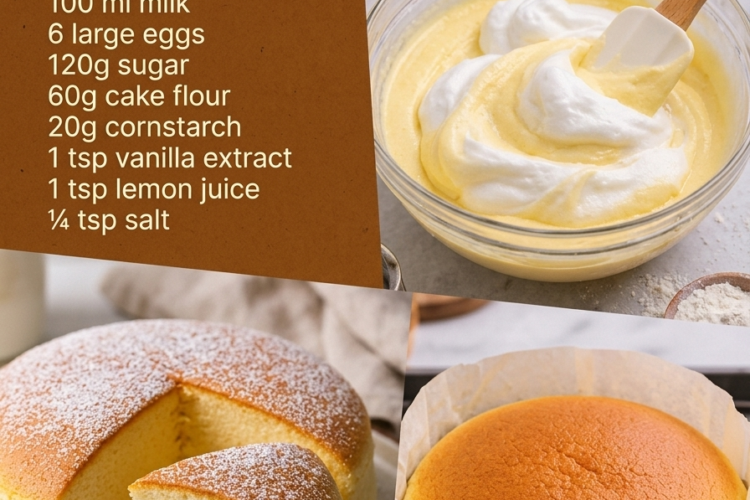
🍰 Classic Japanese Jiggly Cheesecake – Light, Fluffy & Cloud-Like!
Get ready to fall in love with this beautiful Japanese Jiggly Cheesecake! Also known as Japanese Cotton Cheesecake, this delicate dessert is famous for its incredibly soft texture, gentle sweetness, and signature wobble.
Unlike traditional dense New York cheesecake, this Japanese version is wonderfully light and airy, almost like a combination of cheesecake and fluffy sponge cake. It has a creamy cream cheese flavor, a delicate golden top, and a soft, cloud-like center that practically melts in your mouth.
The secret is the combination of a smooth cream cheese batter, carefully whipped egg whites, and gentle baking in a water bath.
It takes a little patience, but the result is absolutely worth it!
Recipe Details
- Prep Time: 25 minutes
- Bake Time: 75–85 minutes
- Cooling Time: 1–2 hours
- Total Time: Approximately 2 hours 45 minutes
- Servings: 8–10 slices
- Difficulty: Intermediate
- Category: Dessert, Cheesecake, Japanese Baking
- Method: Oven-Baked Water Bath
Ingredients
For the Japanese Cheesecake Batter
- 200 g cream cheese, softened
- 50 g unsalted butter
- 100 ml whole milk
- 6 large eggs, separated
- 120 g granulated sugar
- 60 g cake flour
- 20 g cornstarch
- 1 teaspoon vanilla extract, suggested addition
- 1 teaspoon lemon juice, optional
For Preparing the Pan
- 1 teaspoon unsalted butter or neutral oil, for greasing
- Parchment paper, as needed
For Serving
- Powdered sugar, for dusting
- Fresh strawberries
- Blueberries or raspberries
- Whipped cream, optional
- Fresh fruit sauce, optional
Note: All seven main ingredients and their quantities are from your supplied recipe. Vanilla and lemon juice are optional additions for extra flavor.
Instructions
1. Prepare the Baking Pan
Preheat your oven to 320°F (160°C).
Prepare an 8-inch (20 cm) round cake pan, preferably one with tall sides.
Lightly grease the bottom and sides with butter.
Line the bottom with parchment paper and place a tall strip of parchment paper around the inside of the pan. Allow it to extend approximately 2 inches above the rim to give the cheesecake room to rise.
If you’re using a springform pan, wrap the outside securely with 2–3 layers of heavy-duty aluminum foil to help prevent water from entering during the water bath.
Set aside.
2. Separate the Eggs
Carefully separate the six eggs, placing the egg yolks in one large mixing bowl and the egg whites in a separate, completely clean and dry mixing bowl.
Make sure there are no traces of egg yolk in the whites. Even a small amount of fat can prevent the egg whites from whipping properly.
Cover the egg whites and refrigerate them while preparing the cream cheese mixture.
3. Melt the Cream Cheese, Butter, and Milk
Place the cream cheese, unsalted butter, and whole milk in a heatproof bowl.
Set the bowl over a saucepan of gently simmering water, making sure the bottom of the bowl does not touch the water.
Stir gently until the cream cheese and butter melt completely and the mixture becomes smooth and creamy.
Remove the bowl from the heat.
Allow the mixture to cool slightly before adding the egg yolks.
This prevents the warm mixture from accidentally cooking the eggs.
4. Add the Egg Yolks
Add the six egg yolks to the slightly cooled cream cheese mixture.
Whisk gently until everything is completely incorporated.
Add the vanilla extract and lemon juice if using.
Continue whisking until the mixture becomes smooth, silky, and free of lumps.
5. Sift the Dry Ingredients
In a separate bowl, sift together the cake flour and cornstarch.
Sifting removes lumps and helps create the delicate texture that makes Japanese cheesecake so special.
Gradually add the dry ingredients to the cream cheese and egg yolk mixture.
Whisk gently until just combined.
Avoid overmixing, as this can develop too much gluten and make the cheesecake less tender.
For an especially smooth batter, pass the mixture through a fine-mesh sieve.
Set aside.
6. Prepare the Meringue
Remove the egg whites from the refrigerator.
Using a clean electric mixer with a whisk attachment, beat the egg whites on medium speed until they become foamy.
Gradually add the granulated sugar in 3 additions, beating continuously.
Once all the sugar has been added, increase the speed slightly and continue beating until the egg whites reach medium-soft peaks.
The meringue should look glossy and smooth.
When you lift the whisk, the peaks should stand up but gently bend at the tips.
Important: Do not beat the egg whites until they become extremely stiff or dry. Overwhipped meringue can be difficult to fold into the batter and may cause the cheesecake to crack or collapse.
7. Fold the Meringue into the Cheesecake Batter
Add approximately one-third of the whipped egg whites to the cream cheese batter.
Use a silicone spatula to gently fold the mixture together. This first addition helps lighten the heavier batter.
Add the remaining meringue in two more portions.
Fold gently using a circular motion, cutting through the center of the mixture and bringing the batter up from the bottom.
Turn the bowl as you work.
Continue until no large streaks of egg white remain.
Be careful not to overmix or stir vigorously because the air trapped in the meringue is what gives the cheesecake its beautiful fluffy texture.
8. Pour the Batter into the Pan
Pour the finished batter into the prepared cake pan.
Use a spatula to smooth the surface gently.
Tap the pan very lightly against the countertop once or twice to release any large air bubbles.
Avoid tapping too hard, as this can knock out the air from the meringue.
9. Prepare the Water Bath
Place the cake pan inside a larger roasting pan or deep baking tray.
Carefully pour hot water into the larger pan until it reaches approximately 1 inch (2.5 cm) up the sides of the cake pan.
The water bath creates a gentle, moist baking environment that helps the cheesecake cook evenly and reduces the risk of cracking.
If using a springform pan, make sure the foil wrapping is secure before adding the water.
10. Bake the Cheesecake
Place the water bath carefully into the preheated oven.
Bake at 320°F (160°C) for approximately 20 minutes.
Then reduce the oven temperature to 285°F (140°C) without opening the oven door.
Continue baking for another 55–65 minutes, or until the cheesecake has risen, the top is lightly golden, and the center is set but still has a gentle jiggle.
Baking times vary depending on your oven, pan, and the height of the cheesecake.
If the top becomes too dark before the center is ready, loosely cover it with aluminum foil.
11. Cool the Cheesecake Gradually
Once the cheesecake is fully baked, turn off the oven.
Leave the oven door slightly open and allow the cheesecake to rest inside for approximately 10–15 minutes.
This gradual cooling helps reduce sudden temperature changes that can cause the cake to shrink or crack.
Carefully remove the cake pan from the water bath and place it on a wire rack.
Allow it to cool for another 30–60 minutes.
The cheesecake will naturally settle and become slightly shorter as it cools. This is normal.
12. Remove from the Pan
Once the cheesecake has cooled enough to handle, carefully remove the parchment paper and release it from the pan.
Place it on a serving plate.
For the best texture, allow it to cool completely before slicing.
You can serve it slightly warm for an especially soft texture or refrigerate it for a firmer, creamier cheesecake.
13. Decorate and Serve
Dust the top lightly with powdered sugar.
Decorate with fresh strawberries, blueberries, raspberries, or a little whipped cream if desired.
Cut into slices using a sharp knife, wiping the blade clean between cuts.
Serve and enjoy your beautiful homemade Japanese Jiggly Cheesecake!
Expert Tips for Perfect Japanese Jiggly Cheesecake
- Use softened cream cheese: This makes it easier to create a smooth batter without lumps.
- Use room-temperature egg yolks: They blend more easily into the cream cheese mixture.
- Keep the egg whites clean: Even a small amount of yolk or grease can prevent proper meringue formation.
- Don’t overwhip the meringue: Medium-soft peaks create a lighter, more flexible mixture that’s easier to fold.
- Fold gently: The air inside the meringue is essential for the cheesecake’s signature fluffy texture.
- Sift the flour and cornstarch: This helps prevent lumps and creates a smoother batter.
- Use cake flour: It has less protein than all-purpose flour and helps produce a more delicate crumb.
- Don’t skip the water bath: Gentle, moist heat helps the cheesecake rise and cook evenly.
- Avoid opening the oven: Sudden changes in temperature can affect the cake’s structure.
- Cool gradually: A sudden temperature drop can cause the cheesecake to shrink dramatically.
- Don’t underbake: The center should be set enough to hold its structure while retaining a slight jiggle.
- Use a tall cake pan: The cheesecake rises during baking, so leave enough room for expansion.
- Be patient: Proper cooling is just as important as baking when making a delicate Japanese cheesecake.
Delicious Variations
Lemon Japanese Cheesecake: Add 1–2 teaspoons finely grated lemon zest to the cream cheese mixture for a fresh citrus aroma.
Matcha Japanese Cheesecake: Sift 1–2 teaspoons matcha powder with the cake flour and cornstarch for a beautiful green tea flavor.
Chocolate Japanese Cheesecake: Replace approximately 15 g of the cake flour with unsweetened cocoa powder and add 30 g melted, cooled dark chocolate to the cream cheese mixture. The texture may be slightly denser.
Strawberry Japanese Cheesecake: Serve with fresh strawberries and homemade strawberry sauce for a fruity finish.
Vanilla Bean Cheesecake: Replace the vanilla extract with the seeds from one vanilla bean for a more intense vanilla flavor.
Orange Japanese Cheesecake: Add 1 teaspoon finely grated orange zest to the batter for a delicate citrus flavor.
Coconut Japanese Cheesecake: Replace 30 ml of the whole milk with coconut milk for a subtle tropical twist.
Coffee Japanese Cheesecake: Dissolve 1 teaspoon instant coffee powder in a little warm milk and add it to the cream cheese mixture for a gentle coffee flavor.
Blueberry Japanese Cheesecake: Serve with fresh blueberries or a homemade blueberry sauce for a delicious fruity combination.
What to Serve with Japanese Jiggly Cheesecake
This light and airy cheesecake pairs beautifully with:
- Fresh strawberries
- Blueberries and raspberries
- Homemade strawberry sauce
- Raspberry coulis
- Lemon curd
- Lightly sweetened whipped cream
- Vanilla ice cream
- Fresh mango slices
- Peach compote
- Hot coffee or cappuccino
- Japanese green tea
- Earl Grey tea
- Iced matcha latte
Favorite serving idea: Serve a slice with fresh strawberries, a light dusting of powdered sugar, and a spoonful of homemade strawberry sauce. The fruit’s refreshing sweetness balances the creamy cheesecake beautifully.
Make-Ahead and Storage Instructions
Make Ahead: Japanese cheesecake can be prepared one day before serving. Allow it to cool completely, then refrigerate it in an airtight cake container. The texture becomes slightly firmer and creamier as it chills.
Refrigerator: Store the cheesecake covered in the refrigerator at 40°F (4°C) or below for up to 3–4 days.
Freezing: Allow the cheesecake to cool completely. Cut it into individual slices, wrap each slice tightly, and place them in a freezer-safe airtight container. Freeze for up to 1 month for best quality.
Thawing: Transfer frozen slices to the refrigerator and allow them to thaw slowly for several hours or overnight.
Serving: For a soft, delicate texture, allow refrigerated slices to sit at room temperature briefly before serving.
Food Safety: Because this cheesecake contains eggs and dairy, refrigerate it promptly. Do not leave it at room temperature for more than 2 hours, or 1 hour when temperatures exceed 90°F (32°C).
Frequently Asked Questions
Why didn’t my Japanese cheesecake rise?
The meringue may not have been whipped properly, or it may have lost too much air during folding. Make sure the egg whites are clean, beat them to medium-soft peaks, and fold them gently into the batter.
Why did my cheesecake collapse after baking?
Some shrinking is completely normal as the cheesecake cools. However, a dramatic collapse can happen when the meringue is underdeveloped, the batter is overmixed, or the cheesecake is underbaked.
Why is my Japanese cheesecake dense instead of fluffy?
This usually happens when too much air is lost from the meringue during folding or when the egg whites are not whipped sufficiently. Fold slowly and gently, using a silicone spatula.
Why did the top of my cheesecake crack?
Cracking can result from excessive heat, overbaking, a dry oven environment, or sudden temperature changes. A water bath and gradual cooling help prevent this.
Can I use all-purpose flour instead of cake flour?
Cake flour is recommended for the lightest texture. If you don’t have it, you can use the same quantity of all-purpose flour, although the cheesecake may have a slightly less delicate crumb.
Can I make Japanese cheesecake without cornstarch?
Cornstarch helps stabilize the batter and contributes to its tender texture. You can experiment with replacing it with the same amount of cake flour, but the finished texture may be slightly different.
Why is my cheesecake still jiggly in the middle?
A gentle wobble is normal, especially while the cake is hot. However, the center should not look liquid. If it is very loose, continue baking until it is properly set.
Can I make this cheesecake without a water bath?
The water bath is strongly recommended because it provides gentle, even heat. Without it, the cheesecake is more likely to crack, dry out, or develop an uneven texture.
Can I use a springform pan?
Yes! A springform pan is convenient for removing the cheesecake, but it must be wrapped securely in several layers of aluminum foil to prevent water from entering during baking.
Can I use low-fat cream cheese?
Full-fat cream cheese is recommended for the richest and smoothest texture. Low-fat varieties contain more moisture and may affect the final structure.
Can I prepare the batter in advance?
It’s best to bake the batter shortly after folding in the meringue. Leaving it to stand too long allows the air bubbles to escape, reducing the cheesecake’s fluffy texture.
How do I know when the cheesecake is ready?
The top should be lightly golden, the cake should have risen, and the center should be mostly set with a gentle wobble. It should not appear liquid or wet.
Approximate Nutrition Information
Per serving, assuming 10 slices and without optional toppings:
- Calories: 240 kcal
- Carbohydrates: 28 g
- Protein: 6 g
- Fat: 12 g
- Saturated Fat: 7 g
- Sugar: 13 g
- Fiber: Less than 1 g
- Sodium: 120 mg
Nutrition values are estimates and will vary depending on the cream cheese, butter, and other ingredient brands used.
A Little Cloud of Cheesecake Heaven! 🍰❤️
This Classic Japanese Jiggly Cheesecake is a beautiful dessert that proves simple ingredients can create something truly special.
With its delicate golden top, soft cotton-like texture, gentle cream cheese flavor, and signature wobble, every slice feels light, creamy, and wonderfully luxurious.
Whether you’re baking it for a birthday, family gathering, afternoon tea, or simply because you love cheesecake, this recipe is worth every minute of preparation.
Take your time with the meringue, bake it gently in a water bath, and let it cool slowly. Then slice into that beautiful fluffy center and enjoy a little taste of Japanese bakery magic!